How Galleries Create Instagram Content Without a Videographer
Last updated: September 18, 2026
Gallery Instagram without a videographer: batch MOCKLIO cinematic reels from artwork photos, keep event filming for openings, and scale with Atelier or Gallery plans.
Posted by
 Basti
BastiRelated reading
Fine Art Print Retailers: Room Video on Hero SKUs
Fine-art print retailers: unlimited room stills for the catalog; cinematic room video on hero SKUs for PDP and ads. Giclée and limited editions, not POD.
Gallery Content Pack: Reel, Stills, Carousel, Captions
Gallery content pack from one hang: 10s Reel, 12.5s cinematic cut, three stills, carousel, captions. Loop Hub and Share Pack for catalogue teams.
How Galleries Market New Arrivals Online in 2026
How art galleries market new arrivals online: inventory photos, MOCKLIO mockups and cinematic reels, collector email preview, Instagram schedule, and website sync.
Short answer: A commercial gallery with a roster does not need a videographer for catalogue Instagram. Split two jobs: approved files become photoreal room mockups and cinematic reels (MOCKLIO batch, up to 100 files); a phone or photographer covers openings, people, and install. Multi-location programmes need that split even more: catalogue footage is shared; opening footage is site-specific.
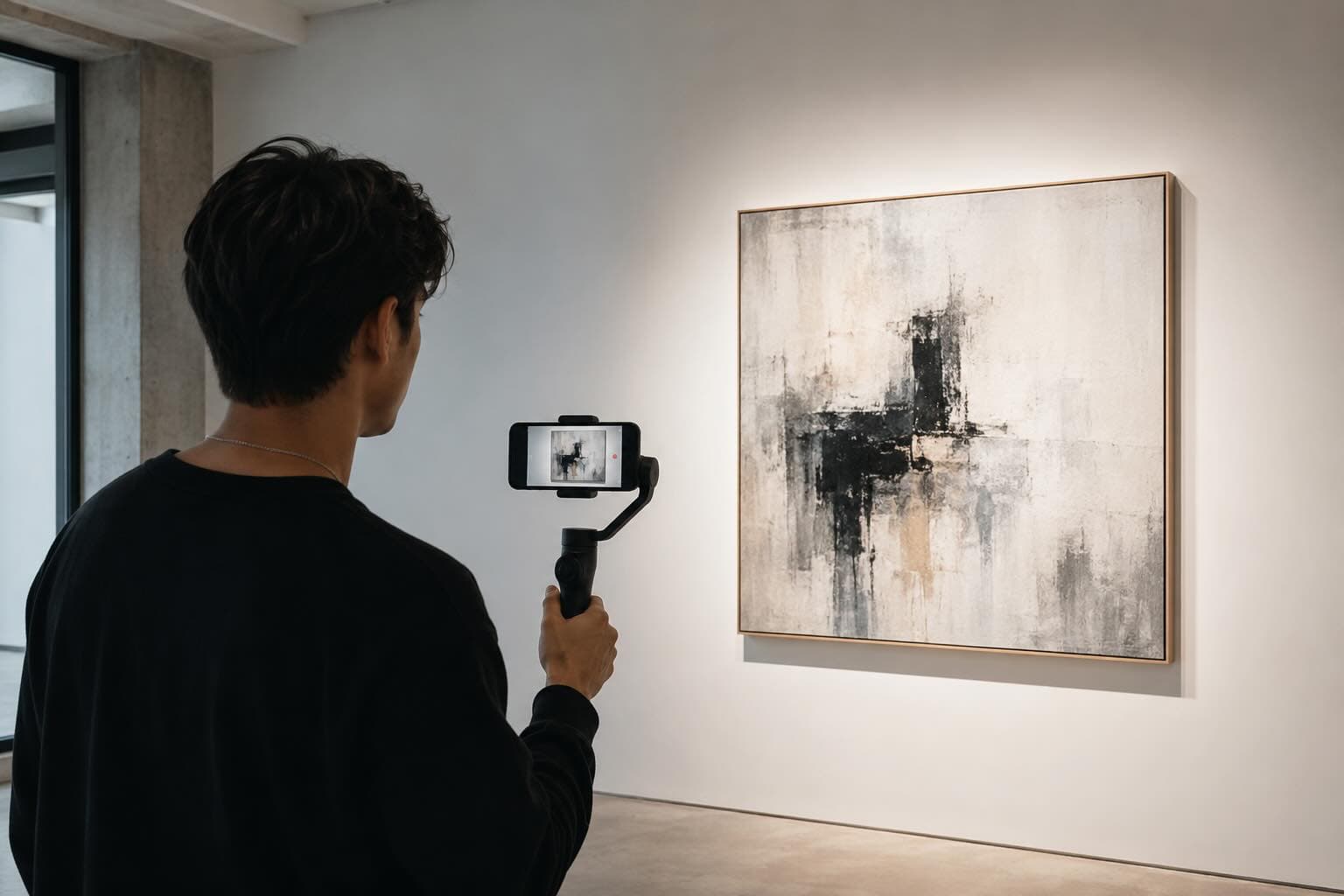
Table of Contents
- I. Separate catalogue content from event content
- II. Build reels from approved artwork files
- III. Batch content around openings and arrivals
- IV. Give each staff role a clear handoff
- V. Publish a multi-artist content schedule
- VI. Run catalogue vs opening footage across locations
- VII. Know when a camera still matters
- FAQ
- Key Takeaways
- Conclusion
I. Separate Catalogue Content From Event Content
Commercial galleries do not need a videographer for every Instagram post because most of the feed is a catalogue problem, not a live filming problem. A roster work already has an approved file and object data. That file can become a room mockup, carousel, and cinematic reel the same week it is released in London, Sydney, or a second city space. An opening night, artist talk, or hang day is different: those posts need a camera because their value is that they happened in that room, on that night.
Treat those as two separate content lanes. The first is a repeatable catalogue lane: works, details, artist context, scale comparisons, and new-arrival announcements. The second is a documentary lane: people, movement through the gallery, voices, crowded rooms, delivery crates, and moments of installation. Trying to make one person film both lanes from scratch is why many gallery accounts become silent between openings.
The catalogue lane should be planned from inventory. Once a work is approved for public presentation, the marketing coordinator has everything needed to make several useful posts: a clean front image, detail crop, dimensions, medium, artist statement excerpt, room mockup, and reel. The output is not fake documentation. It is a clear visual presentation of the work in a plausible context, labeled and used appropriately.
This distinction also makes budgeting more rational. Pay a photographer or videographer for what cannot be reconstructed later: the opening's energy, an artist's voice, a finished installation, and portraits. Use a marketing system for the work that already exists in the inventory system. The gallery gets more consistent publishing without pretending that a generated room is an archival installation image.
For the complete visual workflow, see art gallery marketing software. It frames MOCKLIO as one part of a gallery's content stack, alongside collection management, email, a CMS, and real event photography.
II. Build Reels From Approved Artwork Files
The practical workflow is simple: start with the gallery's approved artwork photo, select a suitable room scene, set believable scale and framing, create still mockups, then create a vertical cinematic reel for Instagram. That turns one cleaned inventory image into the foundation of multiple posts. It also means the marketing team does not wait for a physical install, a weather-safe shoot day, or a freelancer's edit queue.
Quality control begins before upload. The preferred source is a square-on, evenly lit, high-resolution image of the work. Avoid phone snapshots with glare, skewed perspective, shadow from a frame, or clipped edges. If the work is reflective, glossy, metallic, or highly textured, use the flat artwork image as the main source and add detail photography separately. A cinematic reel can show spatial context, but it cannot accurately communicate every surface effect.
Room choice is a curatorial decision. Works about 80cm and up on at least one side belong in collector interiors with real wall height, not poster-scale décor sets. A large gestural canvas reads above a generous sofa. A smaller work needs quieter wall and more negative space. If the piece is 30 centimetres wide, do not hang it as a two-metre centrepiece. Credibility is the whole point.
MOCKLIO composites the gallery's file into photoreal CGI rooms (the artwork is not regenerated). Output is a 10s clip at 30fps and a 12.5s remap at 24fps, 16:9 or 9:16, plus stills and caption carousels in the content pack. Use the reel to earn the stop. Use the carousel and object page for title, medium, dimensions, and the inquiry path.
The purpose differs from the artist-only approach in how to make Instagram Reels as an artist. A gallery is balancing multiple artists, availability states, exhibitions, client relationships, and a shared brand voice. The system needs naming conventions and approval steps, not just a personal posting habit. For technical output details, use room mockup video generation.
III. Batch Content Around Openings and Arrivals
Batch production turns an opening from a one-night communications spike into four to six weeks of material. Two weeks before an exhibition, select six to twelve priority works and generate the room mockups, reels, carousels, story crops, and website images. During the opening, capture real event footage. Afterward, mix the documentary material with the prepared catalogue assets rather than expecting the event footage to do every job.
Start with a campaign board. Each work should have an inventory ID, artist, title, dimensions, availability, featured room, image owner, caption status, web URL, and scheduled channel. Add a column for release phase: teaser, preview, opening week, after-opening, or available works. This can live in a spreadsheet, a project tool, or the gallery's existing collection management workflow. The tool matters less than a single visible source of truth.
A useful batch for a ten-work exhibition includes three hero reels, ten room mockups, two artist-focused carousels, one all-works carousel, six Story sequences, and a small bank of detail crops. That may sound like a large content pile, but it comes from the same ten approved artwork images. Production becomes repeatable when assets are generated in a set, named consistently, and scheduled before public launch.
Use release windows. In the teaser window, show one detail or a cropped room reveal, not every work. In the private collector window, share fuller imagery and checklist access. In opening week, publish the hero reel, finished installation footage, and artist context. In the following weeks, rotate through individual works, client-facing scale context, and a sincere availability update. This is more useful than exhausting the exhibition in three consecutive days.
Teams producing several exhibitions or arrivals each month need throughput, not a one-off template. Scott Linklater, Owner/Founder of Artlandish Aboriginal Art Gallery: no technical knowledge, no photography set-up. Upload, choose the scene, Mockl.io does the heavy lifting. That is the volume bar. The MOCKLIO for galleries path is Atelier at $179/mo (25 videos) or Gallery at $299/mo (50 videos, unlimited stills). Need more volume? Contact us at contact@mockl.io. Start a catalogue trial rather than a Pro artist seat. Confirm limits on pricing.
IV. Give Each Staff Role a Clear Handoff
A no-videographer workflow only works when no one has to guess who owns the next step. The registrar or collections manager verifies object data and provides approved artwork images. The marketing coordinator creates mockups and reels, drafts captions, and schedules posts. The director or artist liaison approves tone, room context, and artist representation. The sales team checks availability and handles collector replies after publication.
Put the approval gate before export, not after scheduling. For every hero work, ask four questions: Is this the approved image? Is the displayed scale plausible? Is the selected room consistent with the gallery's presentation? Is the work actually available at the time of posting? A five-minute approval avoids a public correction that makes the gallery look disorganized.
Make captions modular. The coordinator should pull object facts from the release sheet, then add one short curatorial sentence and one direct action. A good gallery caption starts with artist, title, year, medium, and dimensions. It follows with a line about material, subject, or exhibition context. It ends with a current route: view the work online, request a checklist, or contact the gallery. No staff member should have to rewrite biography facts from memory.
The sales handoff matters just as much as the asset handoff. When a post goes live, the person responsible for inquiries needs a link to the exact artwork page, a copy of the checklist, confirmed shipping information, alternate works, and the current hold policy. A reel can create attention in seconds. A slow, vague response can waste it.
V. Publish a Multi-Artist Content Schedule
A gallery schedule should balance the programme, not reward the artist with the most files ready that week. Use a weekly rhythm that combines one discovery post, one deeper curatorial post, one inventory or availability post, and Stories that point to current programming. That lets the account present several artists without becoming an undifferentiated slide show.
For example, Monday can be a cinematic new-arrival reel. Wednesday can be a carousel that gives the title, medium, detail crop, and room context. Friday can be a real opening clip, artist quote, or installation image. Saturday Stories can point people to the available-works page. The feed is doing different jobs each day: reach, understanding, trust, and action.
Keep a content ratio that protects the gallery's identity. A reasonable starting point is half catalogue and artist content, one quarter event or people content, and one quarter editorial or educational material such as framing, installation, or curatorial context. Adjust based on exhibitions and audience response. The gallery should not become a generic interiors account just because room mockups perform well.
Pair the cinematic reel with a static record. The reel earns discovery. A room mockup carousel makes scale and presentation easy to absorb. The website carries the definitive object page. The art gallery reels guide and art mockups page explain how the two formats work together. Neither replaces the other.
Review performance monthly by artist, format, and action. Saves, profile visits, checklist requests, page clicks, and qualified inquiries are more revealing than likes alone. If a certain room style consistently generates questions about scale, test a different context. If reels generate broad reach but carousels generate inquiries, keep both in the release mix. The aim is a better communications system, not a single viral post.
VI. Run Catalogue vs Opening Footage Across Locations
Multi-location and commercial roster galleries should treat catalogue footage as a shared asset and opening footage as a local one. Catalogue reels hang the same 80cm+ work in a collector interior and can run on every city's Instagram, website PDP, and sales WhatsApp. Opening footage is the crowded room, the speech, the hang crew. It only proves that specific space that night.
If one intern tries to film both jobs with one camera, the feed goes quiet between openings. Contemporary dealers and fine-art print retailers hit the same wall at SKU volume. Batch the catalogue lane from approved files (AI room match up to 100 uploads). Keep the documentary lane on a shot list per site. Do not name a generated room as an archival install shot.
Brand voice stays central. A roster account is not each artist's personal Reels habit. Captions carry artist, title, location of the work, and which space holds the physical piece. The cinematic hang can be identical across cities; the CTA cannot. Point London followers to the London viewing, remote collectors to the object page.
See how Artlandish Aboriginal Art Gallery runs catalogue video without a hire, and the hub on art gallery marketing software.
VII. Know When a Camera Still Matters
Use a camera whenever the post's value depends on a real place, person, or time. Opening night footage, an artist answering a question, a studio visit, installation progression, a collector walkthrough, and an architectural view of the exhibition cannot be replaced by a room mockup. Those moments build social proof and show that the gallery's programme exists in the physical world.
A modern phone is enough for many of these moments. Give one staff member a shot list: exterior signage, empty gallery before guests, two wide installation views, three detail shots, the artist or curator speaking, a ten-second room pan, and a short crowd clip. Shoot vertical first for Stories and Reels. Ask permission when filming identifiable guests, and do not turn a collector conversation into content without context.
Bring in a professional when the work needs high-end exhibition documentation, when lighting is technically difficult, when a major institutional partner requires assets, or when an artist interview carries the campaign. The point is not to eliminate professionals. It is to reserve them for real-world material where their craft adds something a catalogue asset cannot provide.
For a broader stack review, see the best marketing tools for art galleries. Use MOCKLIO for the recurring visual workload, then use photography and video production for documentary work. That split usually creates more consistent output and a better archive.
Related Guides
FAQ
Can a gallery make Instagram reels from artwork photos?
Yes. Start with an approved, high-resolution image of the work, then create a photoreal room scene and cinematic reel through MOCKLIO. Use the result for catalogue-led posts, new arrivals, and collection previews. Keep real installation footage separate and label contexts clearly when that distinction matters.
How much content should a gallery batch for an opening?
For a ten-work exhibition, start with three hero reels, ten room mockups, two carousels, six Story sequences, and prepared website images. Then add real opening-night footage. This gives the gallery enough material for teasers, launch week, and post-opening follow-up without repeating the same asset every day.
Do gallery reels need to feature people?
No. Artwork-first reels work well for catalogue content because they clarify scale and atmosphere without a shoot. People are valuable for event and relationship content: artist talks, openings, installation, and studio visits. Use both lanes so the account communicates works and the active gallery programme.
Which MOCKLIO plan fits a gallery content team?
Catalogue volume lives on Atelier at $179/mo (25 videos) or Gallery at $299/mo (50 videos, about $5.48 per video on yearly). Unlimited stills on those plans. Need more volume? Contact us at contact@mockl.io. Review pricing, then start a Gallery plan trial.
Should a multi-location gallery reuse the same reel in every city?
Yes for catalogue hangs: the work, scale, and interior can be shared. No for opening night: that footage is local proof. Keep captions explicit about which space holds the physical piece, and send inquiries to the right sales desk.
Key Takeaways
- Split catalogue (shared roster files) from opening footage (local, real).
- Hang 80cm+ works in collector interiors; do not use poster-scale décor sets.
- Batch around openings; Gallery is 50 videos/mo, batch up to 100 files.
- Atelier $179 / Gallery $299. Need more volume? Contact us at contact@mockl.io, not a Pro artist seat.
- Keep a camera for openings, people, and install. CGI is the SKU lane.
Conclusion
A roster gallery does not hire a videographer for every SKU. It splits catalogue production from event documentation. Batch photoreal hangs from approved files, share that pack across locations, and spend camera time on the nights that cannot be reconstructed.
Start a catalogue trial on the Gallery plan or read the Artlandish story.
- MOCKLIO Team