Commercial Gallery Instagram: Catalogue vs Opening
Last updated: September 20, 2026
Split commercial gallery Instagram into MOCKLIO catalogue hangs and real opening footage. One roster cadence across locations; camera stays for people.
Posted by
 Basti
Related reading
How to Make an Art Carousel Without Canva
Build an Instagram art carousel from the same room scene as your Reel. No Canva templates. MOCKLIO auto-builds slides and writes the caption.
How to Batch Create Art Content for a Drop
Drop a whole series at once: upload up to 50 artworks, let AI pick a room for each piece, then ship Reels, carousels, and captions together.
Instagram Captions That Sell Art (With Examples)
Captions that sell art name size, room, and where to buy. MOCKLIO writes a Reel caption and a carousel caption for the piece, ready to paste.
Short answer: A commercial gallery Instagram strategy is two feeds sharing one account. Catalogue hangs (photoreal rooms, 10s @ 30fps / 12.5s @ 24fps, stills, carousels) keep the roster visible every week, across every location. Opening footage (people, install, crowd, artist) proves the programme is real. Do not film SKUs on opening night. Do not fake an opening with a room render. Split the jobs.
Key Takeaways
- Catalogue lane: approved files → MOCKLIO hangs. Opening lane: camera only. Never swap those jobs.
- Multi-location accounts die when each space waits for its next opening. Roster cadence is HQ-owned and weekly.
- Same room language across locations. If Mayfair and the second space look like two brands, collectors bounce.
- Artlandish (Scott Linklater): upload, choose the scene, Mockl.io does the heavy lifting. Volume proof is Gallery 50 videos/mo. Need more volume? Contact us at contact@mockl.io, not a one-reel tutorial.
- Qualify on large work: ~80cm+ on a side. Small SKUs read as décor ads. CTA is a Gallery-plan catalogue trial, not Pro.
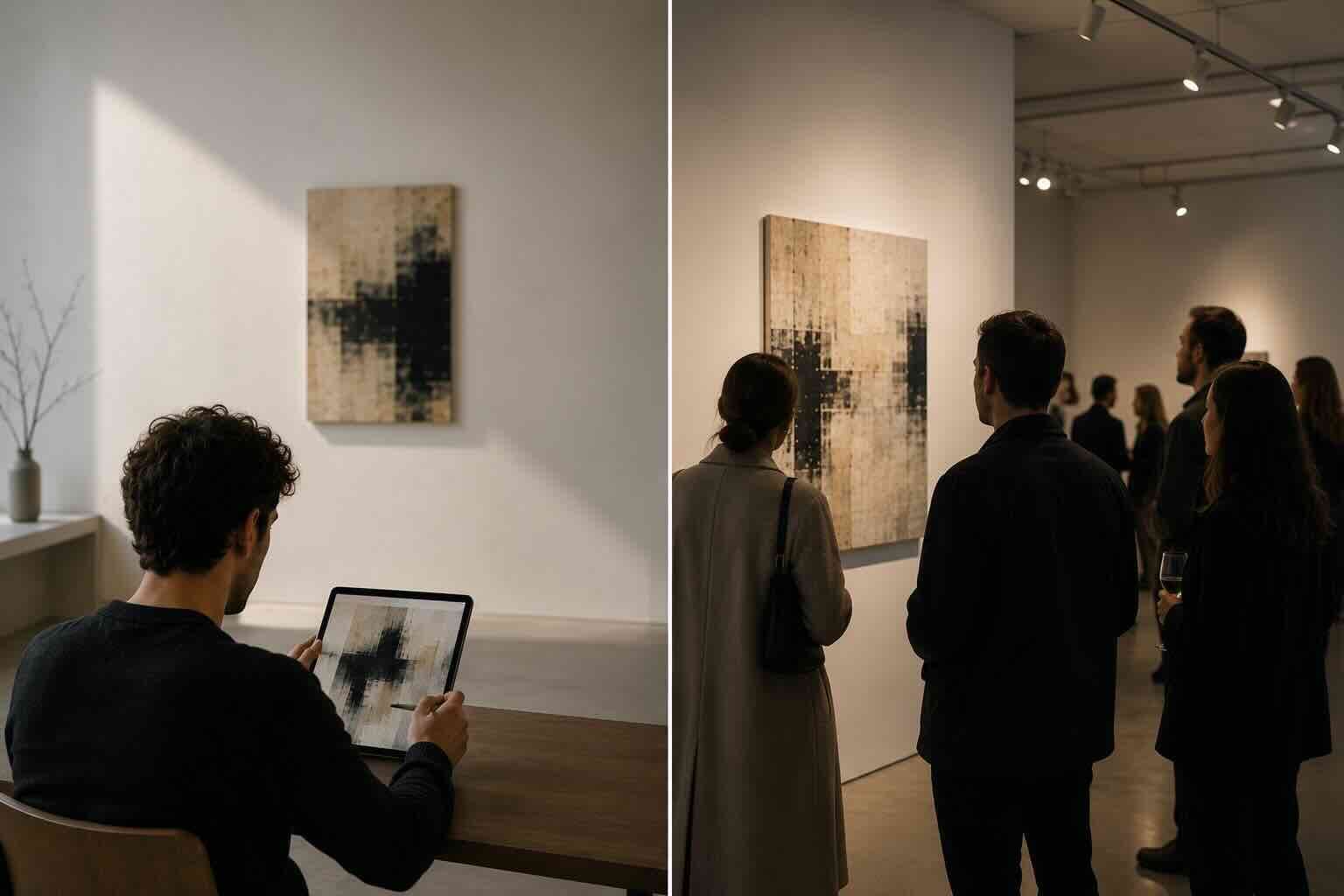
Table of Contents
- I. Catalogue hangs vs opening footage
- II. Roster cadence, not opening spikes
- III. One brand language across locations
- IV. What MOCKLIO owns in the catalogue lane
- V. What stays on a camera
- VI. A weekly mix a marketing manager can run
- FAQ
- Key Takeaways
- Conclusion
I. Catalogue Hangs vs Opening Footage
Commercial gallery Instagram fails when one intern is told to “make Reels.” Catalogue presentation and opening documentation are different products. A hang reel answers: how does this 120cm work sit in a collector interior? Opening footage answers: were people in the room, did the artist show, is this programme alive? Mixing them in one clip usually ruins both.
Catalogue footage starts from inventory: approved square-on files, dimensions, availability. It is SKU work. Commercial programmes rotate dozens of artists and new arrivals every week. That volume cannot wait for a set day. Photoreal CGI rooms composite the gallery's file; they do not invent the painting. Label them as presentation, not as last Thursday's hang.
Opening footage is time-stamped. Crowd density, speeches, install sequence, the street outside, the artist in the space. It cannot be rebuilt later. Pay a photographer or a staffer with a shot list for that night. Do not ask them to also light twenty unsold works for Instagram. That is how openings produce three noisy clips and a dead feed for the next month.
If you need the lean production split (files vs camera, staff handoffs), use gallery Instagram content without a videographer. This playbook is the commercial layer on top: roster, cadence, multi-space consistency. Software for the reel format itself is art gallery Instagram reels.
II. Roster Cadence, Not Opening Spikes
A multi-location commercial gallery does not have a content calendar. It has a roster. New arrivals, holds coming off, editions landing, secondary-market pieces, and works moving between spaces. Instagram should publish that inventory at a steady weekly rate. Openings are spikes on top. If the account only posts when a location throws a party, the brand looks closed between events.
Scott Linklater, Owner/Founder of Artlandish Aboriginal Art Gallery: "You upload the artwork, choose the scene, and Mockl.io does the heavy lifting." No photography set-up. No videography. No editing software. That is the commercial proof point. Not a single-artist Reel tutorial.
HQ marketing owns the cadence. Location teams own the night-of footage. If each space waits until its own opening to post, you get three different posting personalities and weeks of silence. Pull approved files from the collection system, batch hangs, then drip them against the roster, not against whoever shouted loudest in the Slack.
Qualify the work. If a piece is under ~80cm on every side, a luxury room reel often reads as a print-shop décor ad. Commercial programmes selling large originals should hang those first. Small works can sit in quieter scenes or stay as stills. Video credits belong on hero SKUs: new, large, available, and priced for a remote buyer who will never walk the space this week.
Volume math: Gallery plan is $299/month for 50 videos (~$5.48/video on annual). Atelier is $179/month for 25. Need more volume? Contact us at contact@mockl.io. Unlimited stills. Start a catalogue trial on ten of your files, not a Pro signup. See MOCKLIO for galleries and the Artlandish case.
III. One Brand Language Across Locations
Multi-location commercial galleries leak brand when each space picks its own rooms, captions, and cover frames. Collectors follow one handle. They should not be able to tell which intern posted. The hang reel is the brand surface between openings. It has to look like the same house in every city.
Lock a room set. Six to twelve interiors that match the programme: collector living rooms, quiet architecture, hotel-adjacent luxury for large work. HQ exports a short list. Location staff do not freelance a kitchen because it “performed.” Consistency beats novelty. If a second space wants a local flavor, reserve that for opening footage of the actual architecture, not for a random CGI kitchen.
Lock cover-frame rules: artist name, title, dimensions. Same type treatment. Same caption skeleton: object facts, one curatorial line, one route (available-works page, inquiry, viewing). Location name lives in the opening-night posts and Stories, not in every catalogue reel, unless the work is exclusive to that space.
This is the job of multi-location gallery marketing: one content system, many addresses. MOCKLIO is the hang factory. It is not the CRM. Keep inventory truth in the system you already run. Many galleries keep a rooms/CRM tool for stock and use MOCKLIO for presentation. Do not force one product to do both.
IV. What MOCKLIO Owns in the Catalogue Lane
MOCKLIO owns SKU presentation. Upload the approved file. Match a room (manual pick stays primary; batch AI is additive, up to 100 files). Render a cinematic hang: ~10 seconds at 30fps, optional 12.5-second 24fps remap, 16:9 or 9:16. Pull the content pack: both cuts, three stills, carousel, caption carousel, caption reel. That is the commercial unit, not a lone MP4.
The hang uses the artwork they uploaded. It is not generative AI hallucinating brushwork. That objection dies in one sentence if marketing and the director agree on the source image. Scale must be honest. A 180cm canvas on a modest wall is the point. A postage stamp blown to sofa width is how catalogues lose trust.
Catalogue volume is a software batch, not a production company. Scott: no technical knowledge, no photography set-up, no videography, no editing software. “You upload the artwork, choose the scene, and Mockl.io does the heavy lifting.” Use that language with directors. Do not sell “grow as an artist.”
Throughput lives on bulk art reels for galleries and the hub art gallery marketing software. Instagram is one channel. The same pack feeds the website, a collector WhatsApp, a viewing-room deck. The hang is not “social content.” It is catalogue visualization with a Reels wrapper.
V. What Stays on a Camera
Keep a camera for anything whose value is that it happened in that room, on that night, with those people. Opening, private view, install day, artist walkthrough, fair booth, street queue. MOCKLIO cannot and should not replace that. Directors who worry that CGI “cheapens the programme” are usually reacting to fake event claims, not to a labeled room hang of an available work.
Photographers stay hired for install and people. Position MOCKLIO as the complement: they shoot the night; you hang every SKU every week. Do not pitch replacement of their day rate for events. That fight is stupid and you lose the director. The starving-crowd job is the forty unsold large works sitting as JPEGs between openings.
Opening week mix: one or two real clips (crowd, artist, finished hang in the actual space) plus the pre-built catalogue reels for hero works. After the week, stop posting crowd. Return to roster hangs. If the account becomes a nightlife page, collectors stop saving works. If it becomes only CGI rooms, the programme feels like a webshop. The split is the brand.
VI. A Weekly Mix a Marketing Manager Can Run
Run a 3:1 month. Three catalogue posts for every opening or people post. In a quiet month with no private view, the ratio can go to all catalogue plus Stories of the physical spaces. In fair week, invert for seven days, then snap back. HQ sets the ratio. Locations file footage into a shared drive with a naming rule. Marketing schedules. Sales owns the inquiry reply pack.
Example week, two locations, no opening: Monday 9:16 hang of a new 80cm+ arrival; Wednesday carousel (facts + stills + room); Friday 16:9 cinematic for email/site, cropped to Stories. Location Stories can show the actual window or desk, unlabeled as “content.” Next week: different artist, same rooms. That is roster cadence.
Opening week: freeze two catalogue slots. Insert one vertical from the night and one still of the real install. Do not dump twelve crowd clips. The catalogue reels already made in the two weeks before carry the works. The night proves attendance. After seventy-two hours, resume hangs. Collectors buy inventory, not FOMO from a party they missed.
Measure saves, profile visits, checklist clicks, and qualified inquiries by lane. Catalogue hangs should win saves and site clicks. Opening clips should win reach and story replies. If opening clips win everything, your hangs are the wrong rooms or the wrong scale. If hangs win and openings flop, the camera work is the intern phone-in-a-dark-room problem, not a MOCKLIO problem.
Start with ten approved files on an Atelier / Gallery trial. Book the walkthrough if the roster is 50+/month. Do not close on Pro at $19. That plan is the wrong buyer.
Related Guides
FAQ
Should a commercial gallery mix catalogue hangs and opening footage on one Instagram?
Yes, on one handle, as two labeled jobs. Catalogue hangs (MOCKLIO rooms from approved files) keep the roster live every week. Opening footage proves people and place. Do not splice a CGI interior into a crowd clip. Do not film twenty SKUs during the private view. Collectors follow one brand; they need both lanes, not a mashup.
How often should catalogue hangs go out versus opening coverage?
Default to a 3:1 month: three catalogue posts per opening or people post. Quiet months can be all hangs plus location Stories. Fair or opening week can invert for a few days, then snap back. HQ owns the ratio so multi-location spikes do not erase the roster. Gallery is 50 videos/month; batch AI takes up to 100 files.
How do multi-location galleries keep Instagram looking like one brand?
Lock a shared room set, cover-frame type, and caption skeleton at HQ. Location teams file opening footage; they do not pick random CGI kitchens. Put the space name on event posts, not on every hang unless the work is exclusive to that address. One content system, many addresses: see multi-location gallery marketing.
Does MOCKLIO replace opening-night photography?
No. MOCKLIO composites the gallery's artwork file into photoreal rooms (10s / 12.5s, stills, carousel). It does not document a crowd, an artist talk, or the real install. Hire or assign a camera for that. Photographers stay for people and architecture. MOCKLIO is the weekly SKU factory between those nights.
Which MOCKLIO plan fits a multi-space commercial roster?
Atelier at $179/month (25 videos) if the month is thin. Gallery at $299/month (50 videos, about $5.48/video yearly) for a rotating commercial catalogue. Need more volume? Contact us at contact@mockl.io. Unlimited stills. Start a catalogue trial with intent=gallery-plan. Do not close a multi-location programme on Pro at $19.
Key Takeaways
- Two lanes: MOCKLIO catalogue hangs vs real opening footage.
- Roster cadence is weekly and HQ-owned. Openings are spikes.
- Same rooms and type across locations. Event clips carry the address.
- 80cm+ first. Content pack per job, batch up to 100.
- CTA: Gallery / Atelier catalogue trial, not Pro.
Conclusion
Commercial gallery Instagram is a roster machine with occasional proof-of-life. Hang the catalogue in photoreal rooms on a weekly cadence, identical across locations. Film the night when the night happens. That split is how a multi-space programme stays visible without a videographer on retainer and without turning the account into either a party page or a furniture ad.
Upload ten large works. Run the Gallery-plan catalogue trial. Keep the camera for the next opening.
- MOCKLIO Team