Anti-AI Art: How to Prove Your Work Is Handmade
Last updated: November 27, 2026
Show buyers your art is handmade: process videos, WIP photos, signatures, COAs, honest platform labels, and mockups as presentation, not proof.
Posted by
 Sebastian Kluger
Related reading
Short-Form Video Ads for Artists: Hooks and Scripts
Plan Reels and TikTok-style ads for art: 2-second hooks, room mockup reveals, offers, CTAs, UGC vs polished, and three example scripts.
Best Platforms for Art Gallery Advertising (2026)
Compare Meta, Google, Pinterest, marketplaces, newsletters, and local ads for galleries, plus how to make ad creatives without a videographer.
What Makes a Good Artist Portfolio in 2026 (Checklist)
What makes a good artist portfolio: room context, embedded cinematic video, mobile + web layout, and a clear CTA. Build in ~1 minute with MOCKLIO AI or templates.
Short answer: You cannot prove a negative with one file, so build a trail instead. Keep dated work-in-progress photos and short process videos, sign and document each piece, issue a certificate of authenticity (COA) where it makes sense, use platform labels honestly, and show the finished work in context. A room mockup is a presentation of your real artwork, not a substitute for the artwork or for your process evidence.
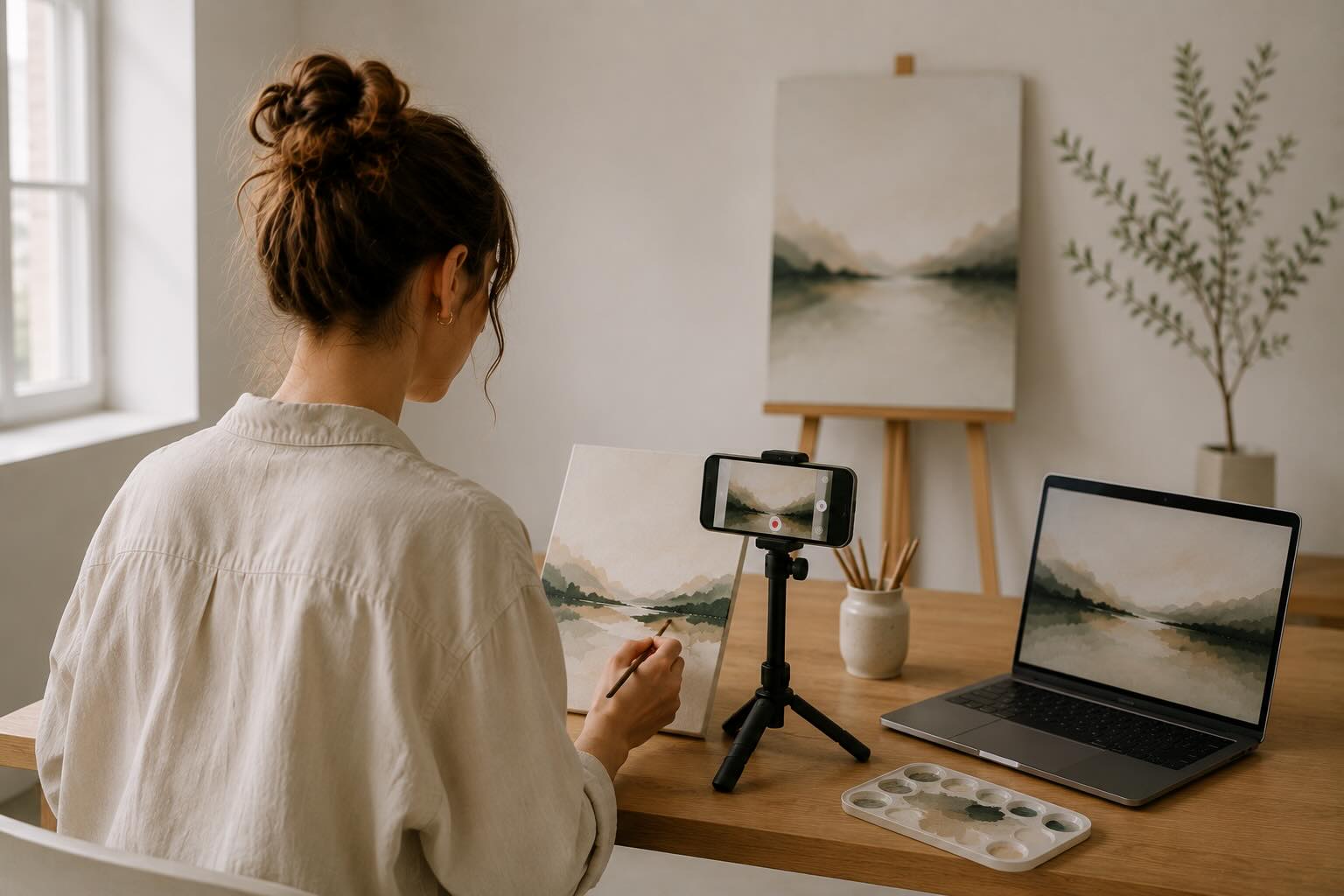
Table of Contents
- I. Why buyers ask, and why that is reasonable
- II. What counts as proof (and what is only presentation)
- III. Proof methods by effort: the comparison table
- IV. Process evidence: WIP and process video
- V. Signatures, COAs, and provenance
- VI. Platform labels and policies
- VII. Where mockups fit (and where they do not)
- VIII. Proof for digital and mixed-media artists
- IX. A one-folder-per-piece workflow
- X. A simple handmade-proof checklist
- XI. Who needs what: collectors, galleries, platforms
- XII. What to say when someone accuses you
- XIII. Common mistakes that weaken your proof
- XIV. How to film a short process clip on your phone
- XV. Captions and listing copy that reduce doubt
- FAQ
- Key Takeaways
- Conclusion
I. Why Buyers Ask, and Why That Is Reasonable
Image generators have made it harder to tell, at a glance, how a picture was made. Some collectors now want to know that a human made the object they are about to hang for years. You do not have to agree with their stance on AI to respond well. A buyer asking "is this handmade?" is asking about provenance, the same question collectors have always asked about authenticity.
This guide stays neutral on AI as a tool. Plenty of artists use it, plenty do not, and both groups benefit from clear disclosure. The goal is simple: make it easy for a buyer to see how your work was made.
The question behind the question
When someone asks whether your painting is handmade, they usually want reassurance on three things: that you made it, that it is the physical object they will receive, and that the price makes sense for how it was produced. None of that is hostile. Treat it as a buying signal, because a person who asks is a person who is considering the purchase.
Why answering early beats answering late
If the answer is already on the page, the buyer never has to ask. A line in the caption, a process clip, and a photographed signature remove doubt before it forms. Doubt that is left alone tends to turn into silence, and silence looks like a lost sale from your side. Your evidence works best as part of the listing, not as a defence you assemble later.
II. What Counts as Proof (and What Is Only Presentation)
Proof is anything that records how the physical work came to exist: dated photos, process footage, a signed and documented object, and a record of where it has been. Presentation is anything that shows how the finished work looks or might look in a space. Both matter, but they answer different questions and should never be swapped.
Evidence answers "how was it made?"
Evidence is time-ordered. A sketch, an underpainting, a mid-point, and a finished piece form a sequence that is hard to produce after the fact. Surface detail adds another layer, because brush ridges, paper tooth, and pencil pressure are physical traces. No single item is a legal certificate, but a coherent sequence is persuasive.
Presentation answers "how will it look?"
A flat photo, a styled studio shot, and a room mockup all belong to presentation. They help a buyer judge colour, scale, and fit. They do not tell anyone how the work was made, and they are not meant to. The trust problem starts only when a presentation image is passed off as something else, such as an installation photo.
A simple test you can apply to any asset
Ask one question: could someone have produced this image without the physical work existing yet? A dated photo of wet paint on a half-done canvas is hard to make that way. A polished room scene is easy to make that way, by design, because it is a visualisation. If the answer is yes, file the asset under presentation and label it accordingly.
III. Proof Methods by Effort: The Comparison Table
Use this table to decide what to do first. The effort column is relative to a normal studio day, and the last column of each row says where the item tends to work best. Start with the low-effort rows and add the rest as pieces get more valuable.
| Method | What it shows | Supports handmade claim? | Effort | Where to post |
|---|---|---|---|---|
| WIP photos | Dated stages from sketch to finish, in order | Yes, as supporting evidence | Low: one phone photo per session | Piece page in your portfolio, carousel, Stories highlight |
| Process video | Hands, tool, and surface in real time | Yes, as supporting evidence | Medium: a fixed phone and 15 to 60 seconds | Reels, TikTok, Shorts, piece page |
| Time-lapse | One continuous session from a fixed angle | Yes, as supporting evidence | Medium: tripod and a long take | Reels, YouTube, piece page |
| Detail and raking-light shots | Brush ridges, paper texture, edges, impasto | Yes, as supporting evidence | Low: a few close photos of the finished piece | Piece page, listing photos, carousel |
| Signature close-up | Your consistent mark and date on the object | Supports authorship and provenance | Low: one photo | Piece page, listing photos, COA |
| Certificate of authenticity (COA) | Title, medium, size, year, edition, your name | Supports provenance on sale | Medium the first time, low once templated | Ships with the work, PDF on piece page |
| Platform labels and captions | Your own plain-language disclosure | Your word, stated openly | Low: one sentence | Caption, listing description, platform label fields |
| Room mockup | How the real artwork could look at scale on a wall | No. Presentation only, not proof of handmade | Low to medium | Hero image on piece page, listings, Reels |
How to read the table
The first four rows are about process. The next three are about the object and the record around it. The last row is presentation and is included on purpose, because artists often lump it in with proof. A good page uses all of them, each in its own role, and labels each one honestly.
If you only have ten minutes per piece
Take three WIP photos across the work, one detail shot of the finished surface, one photo of the signature, and write one plain caption line stating the medium. That is five files and one sentence. It will not satisfy a forensic review, but it answers most buyers in seconds and costs almost nothing.
IV. Process Evidence: WIP and Process Video
Process evidence is the most convincing thing you can show because it is hard to fake at length and easy for you to produce as you work.
- Work-in-progress photos: take a photo at each stage: sketch, underpainting, mid-point, near-finished, final. Keep the originals with their timestamps and do not strip the metadata you may need later.
- Short process video: a 15 to 60 second clip of hands, brush, or tool on the surface. Wide enough to show the canvas and the studio, close enough to show texture.
- Time-lapse: one fixed camera over a session. Not tamper-proof, but a continuous take over hours is more credible than a single polished cut.
- Detail and raking-light shots: physical surface evidence such as brush ridges, paper texture, impasto, and edges. These are hard to read in a thumbnail but persuasive when someone looks closely.
- Materials and studio context: paint tubes, pencils, the easel, the sketchbook the idea came from.
Store everything in one dated folder per piece. If your process is digital, keep layered source files, version history, and screen recordings the same way. Then any question can be answered in a minute instead of a scramble.
How to photograph work in progress
Use the same spot and the same angle each time, so the sequence reads as one object changing. Shoot in daylight if you can, include a corner of the easel or table for context, and avoid heavy filters. You are making a record, not an ad. A slightly plain photo that is clearly yours is worth more than a polished one that could be anyone's.
How to film a process clip that holds up
Put the phone on a stand, frame the surface and your working hand, and let one take run without cuts for at least a short stretch. Natural sound helps, because brush on canvas is hard to mistake for anything else. Avoid heavy speed ramps and effects in the version you keep as evidence. Cut a shorter social edit separately.
Keep the originals, post the edits
Social platforms often compress files and may remove embedded information when you upload. Treat the files on your own drive as the master record and the posted versions as copies. A backup in cloud storage with the original dates intact is a sensible habit, and it takes a few seconds once it is set up.
For a broader look at filming and photographing your studio without special gear, see content creation setup for artists.
V. Signatures, COAs, and Provenance
Paper trails are old technology and still the most accepted form of proof in the art market.
- Sign and date consistently, front or back, in a way that matches your other work. Photograph the signature.
- Certificate of authenticity: title, medium, dimensions, year, edition number if applicable, your name, and a signature. Add a photo of the work so the certificate can be tied to the object.
- Provenance notes: where the work has been shown or sold. For prints, state the printing method, paper, and edition size clearly.
- Invoices and receipts for materials are optional but can support the record if a work is ever questioned.
Some tools now support content credentials, which attach editing and origin information to a file. If your workflow supports it, it is a reasonable extra layer for digital images. Treat it as supporting evidence, not a guarantee.
What a useful COA contains
Keep it to one page. Include the title, year, medium and support, dimensions, edition details if any, the date of sale or issue, your name and contact, and your signature. Add a small photo of the piece so the document and the object are linked. Number each certificate so you can match it to your own records later.
Originals versus prints and editions
The word handmade means different things for an original and for a print, so be precise. For an original, name the medium and support. For a print, name the process, the paper, the edition size, and whether you signed and numbered each one. Buyers react better to clear detail than to vague claims. See limited edition print mockups for presenting editions.
A signature is a habit, not a security feature
A signature on its own can be copied, so do not oversell it. Its value comes from consistency over years, from matching what appears in your photographed work, and from being backed by the COA and process trail. Think of each item as a thread, and the strength as the number of threads that point the same way.
VI. Platform Labels and Policies
Many platforms now ask creators to label AI-generated content, and some artist communities restrict or prohibit it. Rules differ and change often, so read the current policy on each platform where you post or sell: social networks, portfolio sites, marketplaces, and print-on-demand services.
- Use the label or disclosure fields honestly. If your work is handmade, say so in the caption or listing description in plain words: "Handmade, oil on canvas."
- If you use AI for part of a workflow (brainstorming, references, admin), you do not need to hide it, but do not describe such work as purely handmade.
- Be wary of AI "detectors". They are unreliable and have flagged genuine human work. Do not treat a detector score as proof in either direction.
Write a disclosure line you can reuse
Pick a short template and use it everywhere. For example: "Oil on linen, painted by hand in my studio, 2026." or "Pencil on paper, drawn by hand. Process clip in the highlights." Reuse keeps your wording consistent, which reads as confidence. It also saves you from improvising a defensive reply when someone asks.
When a platform changes its rules
Policies on AI content move quickly, and communities set their own standards on top of the platform. Check your main channels every few months, and keep your own site as the stable record. If a rule change affects you, your dated process folder and portfolio page are the materials that carry over to any other place you post.
Mixed workflows deserve plain words
Many artists use digital tools in small ways: colour correction on a photo, a reference search, a caption draft. These are ordinary and you do not need to apologise for them. What matters is that your claim about the artwork itself is accurate. "Painted by hand" should mean painted by hand, and a mixed approach should be described as mixed.
VII. Where Mockups Fit (and Where They Do Not)
Handmade proof and presentation are two different jobs. Process evidence proves how the work was made. A room mockup shows how it might look on a wall. Mixing them up is where trust gets damaged.
MOCKLIO shows your real artwork in rooms. You upload the photograph of your finished piece and it is composited into a photoreal CGI room for stills and a cinematic reel. The artwork itself is not regenerated or altered by the room, which is why this is different from AI image generation. For the technical distinction see art video mockup generator: CGI vs AI, or the shorter CGI vs AI art mockups comparison.
Practical guidelines:
- Lead with the room mockup to help buyers judge scale and fit, then follow with the flat photo, detail shots, and process evidence as the factual record.
- Do not present a mockup as an installation photo or a photo of your studio. Where it matters, call it a visualisation.
- A mockup does not prove the work is handmade, and it is not meant to. It proves you can show the piece well.
See art mockups for the free still workflow, and room mockup video generation for the reel.
Why a mockup helps a handmade seller
Buyers of original work often worry about size and wall presence more than anything else. A room image answers that quickly, which leaves your process material free to answer the authenticity question. Each asset has one job. When both jobs are done, the buyer has both answers without having to ask for either.
How to label a mockup so nobody feels misled
A short note is enough. Something like "Room visualisation of the original, 80 x 100 cm" tells the buyer what they are looking at. Put the real dimensions in the text. Keep the flat photo and a detail shot next to it. The mockup then reads as a helpful extra, and nobody mistakes it for a photograph of a customer's home.
Real photography still has a role
A photo of the piece on your own wall, or in a real exhibition, is a different kind of asset from a mockup. It shows the object in a physical space and can be strong social proof. The trade-offs between the two are covered in art mockups vs real photography. Use real installation photos when you have them, and label mockups when you do not.
VIII. Proof for Digital and Mixed-Media Artists
If you work digitally, your trail looks different but follows the same logic: show how the file came to exist. Layered source files, version history, screen recordings, and exported stages replace canvas photos. The evidence is time-ordered, tied to your account or machine, and easy to keep if you plan for it from the first session.
Keep layered files and version history
Save the working file with its layers intact, and keep several saved versions rather than overwriting one. Many drawing and painting applications keep a history of actions or let you export a stroke replay. Check what yours offers. A layered file with a visible build from rough shapes to final detail is a strong record of authorship.
Screen recordings as process video
A screen recording is the digital equivalent of a studio clip. Record a stretch of a normal session, with your brush strokes and layer changes visible. A few minutes spread across the project can be edited into a short reel later. Keep the raw recording as the master copy, in the same dated folder as the source file.
Prints of digital work and mixed media
When a digital piece is sold as a print, describe the object, not only the origin: printing method, paper, size, and edition. For mixed media, list each medium in the order you used it. Hand-finished prints should say so and say what was added by hand. Specific wording lets a buyer value the object accurately.
IX. A One-Folder-per-Piece Workflow
The simplest system is one folder per artwork, created on day one, with the same subfolders every time. It takes a minute to set up and saves hours later. When a buyer, a gallery, or a platform asks, you zip the folder and send what is relevant without searching through a phone camera roll.
A folder structure that stays simple
- 01_WIP: dated photos and short clips, in order.
- 02_Final: the flat photo, detail shots, and a photographed signature.
- 03_Paperwork: COA, edition notes, invoices, and any exhibition records.
- 04_Presentation: room mockups, social edits, and carousel files, clearly named as visualisations.
A rhythm that fits real studio days
Take a WIP photo at the end of each session, before you clean your brushes. Film a clip when something interesting happens, such as a big layer of colour going down. Photograph the signature when you sign. Doing each at the moment it happens costs seconds. Doing them all after the piece is finished costs a lot of memory and rarely works.
X. A Simple Handmade-Proof Checklist
Put the evidence where buyers actually look: your portfolio. A dedicated page or section per piece can hold the room mockup, flat image, details, process video, and any certificate in one place. The artist portfolio pages in MOCKLIO are built around this layout, and what makes a good artist portfolio covers the structure.
- Dated WIP photos for each piece, saved in one folder.
- One short process video, with sound or captions.
- Close-up detail and raking-light shots of the surface.
- A photographed signature and date.
- A COA or edition note for sold or editioned pieces.
- A plain-language line in the caption: medium and how it was made.
- Room mockups for scale, labelled as visualisations.
- A short "how I work" paragraph on your site or bio.
How to lay out a piece page
Order matters. Start with the hero image, either the flat photo or a room visualisation. Follow with the title, medium, and dimensions in text. Then add detail shots, the process clip, and the signature photo. Finish with the COA note and a single route to inquire or buy. A buyer scrolling once should see both the look and the proof.
A "how I work" paragraph that earns trust
Write four or five sentences in the first person. Say what you make, which materials you use, roughly how long a piece takes, and where you work. Avoid slogans. Plain facts about your studio carry more weight than a manifesto, and a buyer who reads them once will remember the voice behind the work.
XI. Who Needs What: Collectors, Galleries, Platforms
Different audiences want different amounts of proof. A casual buyer wants a quick, friendly answer. A gallery wants consistency and paperwork. A platform wants an honest label. Matching the response to the audience keeps you from over-explaining to some people and under-delivering to others.
Collectors
Most collectors respond to a process clip, a signature photo, and a clear caption. Those who spend more usually also expect a COA and clean provenance. For a view of how buyers weigh these signals, see how collectors decide to buy art online. Offer the extra material proactively on higher-priced pieces.
Galleries and curators
Galleries tend to value consistent documentation across a body of work, plus a clear statement of medium and edition. A tidy portfolio with process material for each piece signals that you are easy to work with. The submission side is covered in what galleries look for in artist submissions.
Platforms and marketplaces
Platforms mostly need an honest disclosure and, occasionally, evidence if a post is reported. Keep your process folder ready and your description specific. If you sell on a marketplace, read its listing rules for handmade claims, because those rules can be stricter than social platforms and differ from site to site.
Commission clients
Commission clients often like to watch the work happen. Share WIP updates as a courtesy, and it doubles as your record. A client who has seen three stages of a portrait rarely questions the final one. For presenting proposals, see art commission sales and mockups.
XII. What to Say When Someone Accuses You
If someone comments that your work looks AI-generated, a calm, specific answer works better than a defensive one. Reply once, share the process material, and move on. Something like: "Handmade, oil on canvas. Here is a short clip from the studio." Do not argue in the comments or attack the person asking, and do not turn the thread into a debate about AI in general.
If a platform or a buyer asks for evidence formally, send the dated photos, the process video, and the COA. Having them ready is the whole advantage of keeping the trail.
Short replies you can adapt
- Public comment: "Handmade, gouache on paper. Here is a clip from the studio."
- Direct message from a buyer: "Happy to share. I have dated photos from each stage and a certificate that ships with the piece."
- Platform review: "Attached are dated work-in-progress photos, a process video, and the signed certificate for this piece."
What to avoid saying
Skip sarcasm, skip generalisations about people who use AI, and skip claims you cannot back up. If part of your process involved a digital tool, say so accurately instead of denying it. A short, factual reply with a link or a clip ends most threads. A long emotional one extends them and gives screenshots to people who were not part of the original conversation.
When the accusation is wrong and it persists
Sometimes a thread keeps going anyway. Post your process clip as its own item, pin it, and stop replying in the original thread. If a platform offers an appeal or review route, use it with your dated material attached. Keep screenshots of the exchange. You do not need to win the crowd, only to have a record you can point to.
XIII. Common Mistakes That Weaken Your Proof
Most trouble comes from small gaps, not big ones: files without dates, vague captions, or a presentation image used as if it were a photo of the real thing. These are easy to fix once you know them, and fixing them also makes the rest of your portfolio look more professional.
Treating a mockup as a document
A room mockup is a visualisation, and it should not be used to answer a question about how a piece was made. If a buyer asks about process, send WIP photos and a clip. Sending a polished room scene in reply feels like a dodge, even when it is not meant that way.
Deleting the messy stages
Artists often delete early photos because they look rough. Those rough stages are exactly what makes the sequence credible. Keep them, even if you never post them. You can choose later which ones to show, but you cannot recreate them after the fact.
Relying on a detector score
Running your own image through an online detector and posting the result invites an argument you cannot win, since the tools disagree with each other and can be wrong in either direction. Show process instead. A clip of a brush on a canvas is clearer than any percentage.
Vague wording in listings
Phrases like "original art" or "hand finished" can mean several things. Name the medium and the process in plain words. Say what is signed, what is numbered, and what ships. A precise listing answers questions before they are typed and avoids disputes after the sale.
Waiting until someone asks
Starting a trail after a challenge is much harder than keeping one from the beginning. If your back catalogue has no process material, begin with new work, and add what you can for older pieces: signature photos, current detail shots, and a COA. Partial coverage beats none, and it improves with every piece.
Related Guides
XIV. How to Film a Short Process Clip on Your Phone
A thirty to sixty second clip is enough for most listings. You do not need a studio, a mic boom, or a polished edit. You need a clear view of your hands and the surface changing over time. Shoot while you work, not as a separate project after the piece is finished.
Setup that works in a real studio
Prop the phone on a stable shelf or clamp, landscape or portrait depending where you will post, and lock exposure if your phone allows it. Use window light or a desk lamp from the side so brushstrokes and texture read clearly. Avoid heavy filters. A quiet room is better than loud music that drowns out the sound of tools, because that ambient sound is part of the proof for many buyers.
What to capture in one minute
- Opening frame: blank or early stage of the support (canvas, paper, panel).
- Mid frame: active mark-making with your hands in view.
- Close detail: wet paint, graphite sheen, fibre, or glaze catching light.
- Closing frame: signature or your initials on the piece, then a wider shot of the finished work on the easel or table.
Trim on your phone. Keep the longest continuous stretch of real work. If you use speed-up, say so in the caption so viewers know it is compressed time, not a generated clip. Pair the video with still WIP photos from the same session in your piece folder.
Where the clip belongs
Pin it in Stories highlights, attach it to the shop listing when the platform allows video, drop it into a Reel or TikTok with a calm caption, and keep the file next to your COA. When someone asks how the work was made, you send one link instead of rebuilding the story from memory. For room context after the proof is clear, use a still or cinematic room mockup from MOCKLIO art mockups and label it as a visual of the finished piece in a room, not as a photo of the studio process.
XV. Captions and Listing Copy That Reduce Doubt
Clear language beats defensive language. State medium, support, year, size, and how the piece was made in the first few lines. Buyers skim. If the handmade story is buried below shipping policies, many never see it.
A simple caption template
Title. Medium on support, year. Dimensions. One sentence on process ("Oil on linen, painted in my studio over three weeks"). One sentence on what is included (COA, wired, open edition of prints). One clear next step (inquire, buy, or visit the portfolio). Then hashtags or tags as needed. Keep the process line factual. You do not need to lecture about AI.
What to say about mockups in the same listing
If the first image is a room mockup, add a short note: "Room image is a presentation mockup of this original; process photos and detail shots follow." That single sentence protects trust. It also trains collectors to expect both: context for the wall, and evidence for the object. More on that split in art mockups vs real photography.
Emails and DMs
When a collector messages, reply with the piece folder highlights: one WIP, one detail, the COA PDF or photo, and the listing link. Stay calm and specific. If they ask about AI, answer the question they asked, then offer a video call or studio visit for high-ticket work. You are documenting a practice, not winning an argument.
FAQ
How can I prove my art is not AI-generated?
Keep a trail: dated work-in-progress photos, a short process video, close-ups of the physical surface, a photographed signature, and a certificate of authenticity. No single item is conclusive, but together they make handmade provenance easy to see.
Do AI detectors work for checking artwork?
They are unreliable and can mislabel genuine human work. Do not use a detector score as proof, and do not worry that a score outweighs your documented process.
Is using a room mockup the same as using AI?
No. A room mockup places your finished artwork photo into a scene to show scale and context. MOCKLIO composites the artwork into CGI rooms rather than generating it. It is presentation, not creation, and it is not evidence that something is handmade.
Should I label my work as handmade?
Yes, if it is true. State the medium and how it was made in plain words in the caption or listing, and use any platform disclosure or label fields honestly.
Where should I put process evidence for buyers to see?
On the work's own page in your portfolio, next to the room mockup and flat image, and in a short caption or highlight on social. Buyers who care will look at the page, not the feed.
What is the minimum proof worth keeping for each piece?
Three dated work-in-progress photos, one detail shot of the finished surface, one photo of the signature, and a one-line caption stating the medium. That takes a few minutes per piece and answers most buyer questions. Add a process video and a certificate for higher priced work.
Can I still use mockups if I sell handmade work?
Yes. Mockups help buyers judge scale and fit, and they use your real artwork photo. Label them as visualisations, show real dimensions in text, and place them next to the flat photo, detail shots, and process evidence. They complement proof and do not replace it.
How should digital artists show their work is original?
Keep layered source files, saved versions, and screen recordings in a dated folder, and show a short build from rough shapes to final detail. For prints, describe the printing method, paper, and edition clearly so the physical object is documented as well as the file.
Key Takeaways
- Build a trail: dated WIP, process video, surface detail, signature, and COA.
- State how a work was made in plain language and use platform labels honestly.
- Do not rely on AI detectors in either direction.
- Mockups show scale and fit. They are presentation, not proof of process.
- Keep everything on one portfolio page per work so questions are easy to answer.
- Use one dated folder per piece and capture evidence as you work, not afterwards.
- Answer calmly and once when accused, with process material instead of arguments.
Conclusion
Buyers do not need you to win an argument about AI. They need to see who made the work and how. Document as you go, say what you made in plain words, and show the finished piece in rooms so people can picture it on their wall.
Try Mocklio to show your real artwork in photoreal rooms and cinematic reels.
- Basti, MOCKLIO