Etsy's new photo rules (Oct 22, 2026): where wall art sellers can still use mockups
Last updated: November 4, 2026
Etsy's Oct 22, 2026 listing photo rules: keep one unedited photo of the actual print, then use accurate room mockups for the rest. We make MOCKLIO.
Posted by
 Sebastian Kluger
Related reading
Etsy Video and Instagram From One Art File
One artwork file: 10-second clip for Etsy listing video and Instagram Reels, plus a 12.5-second cinematic cut for slower posts.
Instagram Captions That Sell Art (With Examples)
Captions that sell art name size, room, and where to buy. MOCKLIO writes a Reel caption and a carousel caption for the piece, ready to paste.
Reels vs Carousels for Selling Art in 2026
Reels win reach. Carousels win saves, size, and price. Buffer 2025: Reels get 125% more reach than single images. MOCKLIO builds both from one scene.
Short answer: From 22 October 2026, Etsy requires at least one unedited photo of the actual item against a real background. Other photos may be edited or generated if they accurately show the item. Accurate room mockups still belong in the rest of a wall-art listing. Put the most realistic photo first. We make MOCKLIO. This is not Etsy documentation and not an Etsy endorsement.
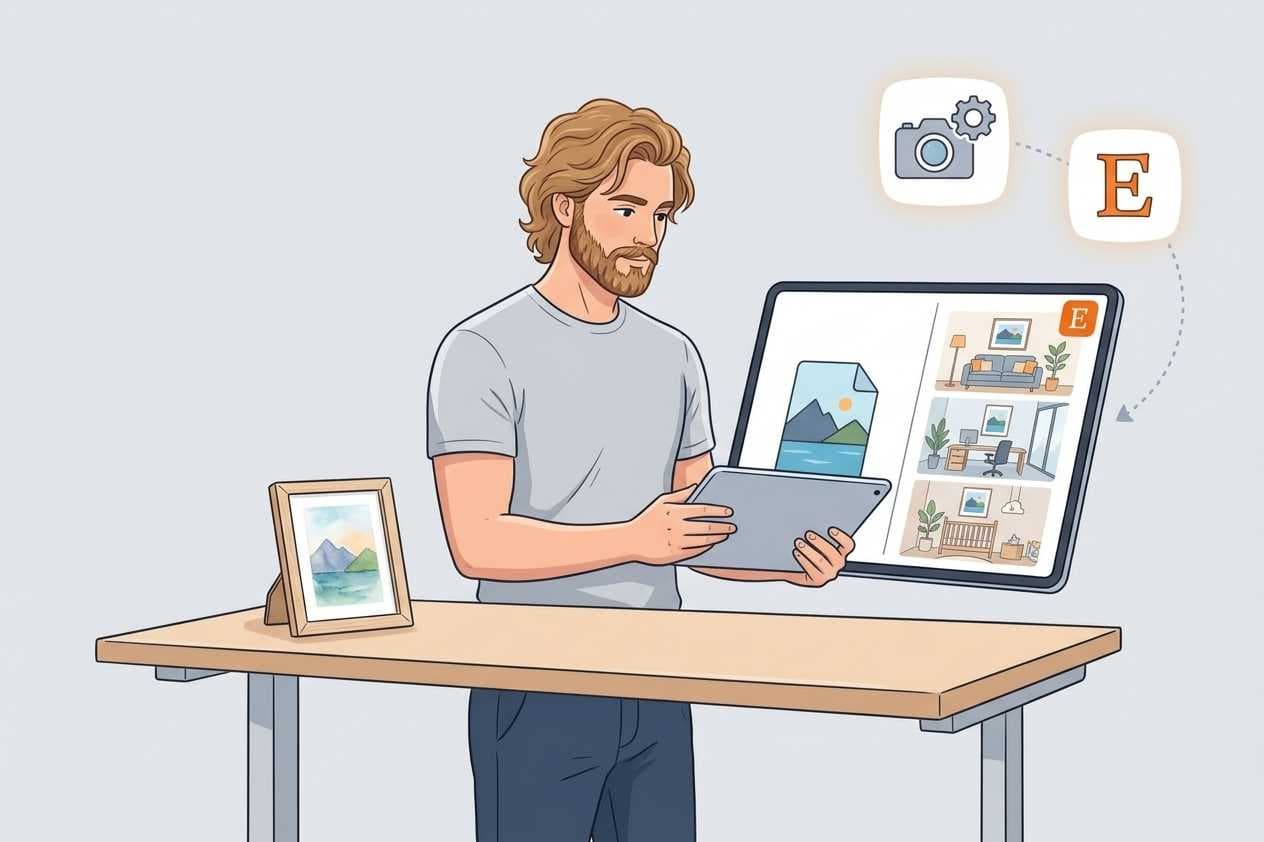
Table of Contents
- What changed on 22 October 2026
- What “unedited” and “real background” mean
- What Etsy still allows besides that photo
- How to shoot the proof photo
- How to keep using room mockups
- A 10-slot listing order that stays compliant
- POD, framed SKUs, and listing video
- Mistakes that still get listings flagged
- MOCKLIO's role (we make MOCKLIO)
- FAQ
- Key takeaways
What changed on 22 October 2026
Etsy updated listing photo rules so buyers can tell what they will actually receive. The Seller Handbook article on listing photos and the Help Center article on photography requirements are the primary sources. This page restates those rules for wall-art sellers who ship prints, canvases, and framed pieces. It is not Etsy documentation.
At least one photo must be an unedited photo of the actual item against a real background. That is the listing's proof shot: the print, canvas, or framed piece you ship, photographed as it is, not composited into a CGI room.
The most realistic photo should come first. If a shopper opens the listing, the first image should be the one that most closely matches the physical item. Lifestyle rooms, close-ups, and video still belong in the gallery — after that proof shot.
The listing form can warn when an image looks AI-detected. Treat that as a prompt to keep the required real photo in slot one, not as a ban on lifestyle shots. Etsy can change enforcement. Recheck the handbook if a warning appears on a listing you already published.
Nothing in the October update says room mockups are forbidden. It says the catalog must include one honest photograph of the object. Sellers who already led with a styled interior and never showed the paper now have a compliance gap. Sellers who already shot the print on a table and then added rooms are already in the shape Etsy wants.
What “unedited” and “real background” mean for wall art
For a print shop, “actual item” is the sheet, canvas, or framed object that leaves your studio or the POD facility — not the digital master file sitting in Lightroom. Photograph that object.
“Unedited” means do not retouch the object into a different product: no swapping the image on the paper, no stretching the canvas, no adding a frame that is not on the SKU. Cropping a messy table edge and setting white balance so the paper looks like the paper is how you make a usable proof photo. If you are unsure, shoot JPEG and skip filters that restyle the piece.
“Real background” means a physical surface — wall, table, floor, shelf — not a generated interior. A blank studio wall counts. A CGI living room does not. You do not need a hired set. You need the object in real space with light that exists in the room.
If you sell multiple sizes, the proof photo should match the variation the buyer is looking at, or the listing copy should say which size is shown. Do not use a 24×36 room still as the only size cue on an 8×10 SKU.
What Etsy still allows besides that photo
Other photos may be edited or AI-made if they accurately show the item. A room mockup that keeps your uploaded artwork intact — scale, crop, and colors as you sell them — is that kind of additional photo. The job of photos 2–10 is still to sell the hang: sofa height, wall color, frame, and mood.
Print-on-demand sellers may use a stock mockup the owner authorized. If you generate mockups in a tool you have a license to use, that authorization is the license, not a marketplace endorsement. You still include the unedited item photo.
Listing video is still available. A room Reel of the same artwork file can sit in the video slot. The cover image for the listing should remain the realistic still — for a physical print, the proof photo.
Etsy publishes the rules; tools do not certify listings. Do not write “Etsy-approved mockups” in tags, titles, or ads. We make MOCKLIO. We do not speak for Etsy enforcement.
How to shoot the proof photo
Hang or lay the actual print on a real wall or table. Stand square to the piece. Use daylight or a single soft lamp. Fill the frame with the object plus a strip of real background so it is obvious this is not a floating PNG.
- Use the print you ship, not a screen screenshot of the file.
- Keep the camera parallel to the paper so you do not keystone the rectangle.
- Turn off beauty modes and HDR looks that shift color away from the ink.
- Include a few inches of wall or table. That is the “real background.”
- If you sell framed, shoot the framed SKU. If you sell unframed, shoot the unframed sheet.
One proof photo per physical SKU is enough for compliance. Extra angles of the real object (corner, signature, hanging hardware) can fill later slots. They do not replace slot one.
How to keep using room mockups
Room mockups still do the conversion job they always did: they show scale and atmosphere. The October rule only changes the order. Proof first. Lifestyle second. Same artwork file in both.
- Photograph the actual print or canvas on a real wall or table. No filters that change the object. That file is listing photo 1.
- Add room mockups as photos 2+. Keep the artwork file identical to the print you sell. Set scale to the real size.
- If the mockup shows a frame you do not include, say so in the listing. MOCKLIO frames are black, white, gold, or wood.
- Optional listing video can be a room Reel of the same file. Still keep the unedited still as the first image.
- For the upload flow and a 10-photo plan, use the Etsy art mockup generator. For catalog volume, see bulk art mockups for Etsy sellers.
Accuracy is the test Etsy describes for additional photos. If the mockup crops the work, changes colors, or hangs a 36-inch piece over a sofa as if it were a postcard, it is no longer an accurate show of the item. True-to-scale placement is not a nice-to-have after October 2026. It is how you stay inside “accurately show the item.”
A 10-slot listing order that stays compliant
Etsy search and ads use the first image. After 22 October 2026 that first image should be the realistic item photo. Rooms still belong in the carousel. Suggested order:
- Unedited item on a real background (required).
- Living-room still at true scale — this is the lifestyle hero inside the listing.
- Second room (bedroom, loft, or office).
- Alternate wall or furniture so scale reads twice.
- Close-up of paper, canvas tooth, or signature on the real piece.
- Size context in a room at the SKU size.
- Framed vs unframed if you sell both.
- Detail you actually ship (border, hardware, certificate).
- Extra room or packaging. Skip stock interiors that are not your art.
- Optional listing video: room Reel of the same file. Cover still remains photo 1.
If you only have four strong assets, fill 1–4 well rather than repeating the same CGI angle ten times. Duplicate mockups with different crops do not help compliance or conversion.
POD, framed SKUs, and listing video
Print-on-demand: you may not hold the inventory, but the buyer still receives a physical print. Get an unedited photo of that product on a real background — from your sample, or from a process your POD partner allows — and keep authorized mockups in later slots.
Framed and unframed variations are different items if the buyer can choose either. Photograph what you ship for each. Generate matching mockups. Do not use a gold-frame still on the unframed SKU.
Listing video does not replace the proof still. A MOCKLIO video render is $12 and delivers Each render is a ~10 s Reel at 30 fps plus a 12.5 s cinematic cut at 24 fps, 16:9 or 9:16. Typical render time: Depends on scene and current usage (usually between 1.5h and 5h). Stills download instantly. Do not wait on video to fix slot one.
Digital download listings are a different product type. This article is for wall art you ship. If you sell files only, read Etsy's current photo rules for that category instead of copying a print-shop proof shot.
Mistakes that still get listings flagged
- CGI room in slot one, real print buried in slot seven.
- Mockup scale that does not match the variation (36-inch art over a sofa on an 8×10 listing).
- Frame in the mockup that is not in the SKU, with no caption.
- Beauty-filtered proof photo that no longer looks like the ink.
- Writing “Etsy-approved” or implying the marketplace endorses a mockup tool.
- Using someone else's interior photograph as if it were your product shot.
MOCKLIO's role
We make MOCKLIO. MOCKLIO is a marketing studio for artists and galleries: unlimited free room mockup stills (instant download, typically under 1 second), $12 cinematic Reels, a 1080×1440 carousel generator, captions, and a Smart Portfolio with shop and 0% commission inquiries. Artwork is placed as uploaded, not regenerated by AI. AI is used only to choose a room in the batch process. Commercial use of stills and video is allowed. This article is written by Sebastian Kluger, founder.
MOCKLIO does not replace the proof photo. It fills photos 2+ and, optionally, listing video, carousel, and a portfolio shop. Unlimited front-view stills are free forever, no watermark, no credit card. Stills download instantly (typically under 1 second). Video is $12 per render.
Related: free Etsy art mockup generator, art mockups for Etsy sellers, free wall art mockup generator, how to mockup a painting in a room.
FAQ
Can I use room mockups as the only photos on an Etsy wall-art listing?
No. Keep at least one unedited photo of the actual item against a real background. Mockups go after that.
Can a MOCKLIO still be the first photo?
The most realistic photo should come first. For a physical print, that is the unedited photo of the item, not the CGI room.
Are MOCKLIO mockups allowed as additional photos?
Additional photos may be edited if they accurately show the item. Place the artwork as uploaded, at real scale. We make MOCKLIO; we do not speak for Etsy enforcement.
What about POD stock mockups?
Print-on-demand sellers may use a stock mockup the owner authorized, per Etsy's Help Center. A MOCKLIO export you generated under the product terms is your authorized mockup of your art, plus the required real-item photo.
Does an AI-detected warning mean I cannot use MOCKLIO stills?
The form can warn on images that look AI-made. Keep the unedited item photo in slot one. MOCKLIO composites your file into a CGI room; it does not regenerate the artwork. Recheck the handbook if a warning appears.
Can listing video replace the proof photo?
No. Video is extra. Slot one is still an unedited still of the actual item on a real background.
Key takeaways
- From 22 October 2026: one unedited photo of the actual item on a real background is required.
- The most realistic photo goes first. For prints you ship, that is not the CGI room.
- Accurate room mockups still belong in photos 2+. Match scale and frame to the SKU.
- POD shops may use an authorized stock mockup and still need the real-item photo.
- We make MOCKLIO. We are not Etsy. Do not write “Etsy-approved.”
Sources: Etsy Seller Handbook, listing photos; Etsy Help Center, photography requirements. Last checked 2026-11-04.