Why Large Works Die as Flat Photos (What 80cm+ Needs Online)
Last updated: October 3, 2026
Flat photos flatten 80cm+ canvases on phones. Show scale with a photoreal room hang plus cinematic camera. Artlandish: buyers need a real home, not a stamp.
Posted by
 Basti
Related reading
How to Make an Art Carousel Without Canva
Build an Instagram art carousel from the same room scene as your Reel. No Canva templates. MOCKLIO auto-builds slides and writes the caption.
How to Batch Create Art Content for a Drop
Drop a whole series at once: upload up to 50 artworks, let AI pick a room for each piece, then ship Reels, carousels, and captions together.
Instagram Captions That Sell Art (With Examples)
Captions that sell art name size, room, and where to buy. MOCKLIO writes a Reel caption and a carousel caption for the piece, ready to paste.
Short answer: A flat photo on a phone is a scale assassin for works ≥80 cm. The canvas becomes a postage stamp. No sofa, no door, no wall run. Remote buyers cannot imagine the piece in a real home. What 80cm+ needs online is a photoreal room hang plus a cinematic camera pass that uses furniture as a ruler. Static catalogue crops stay necessary. They are not enough.
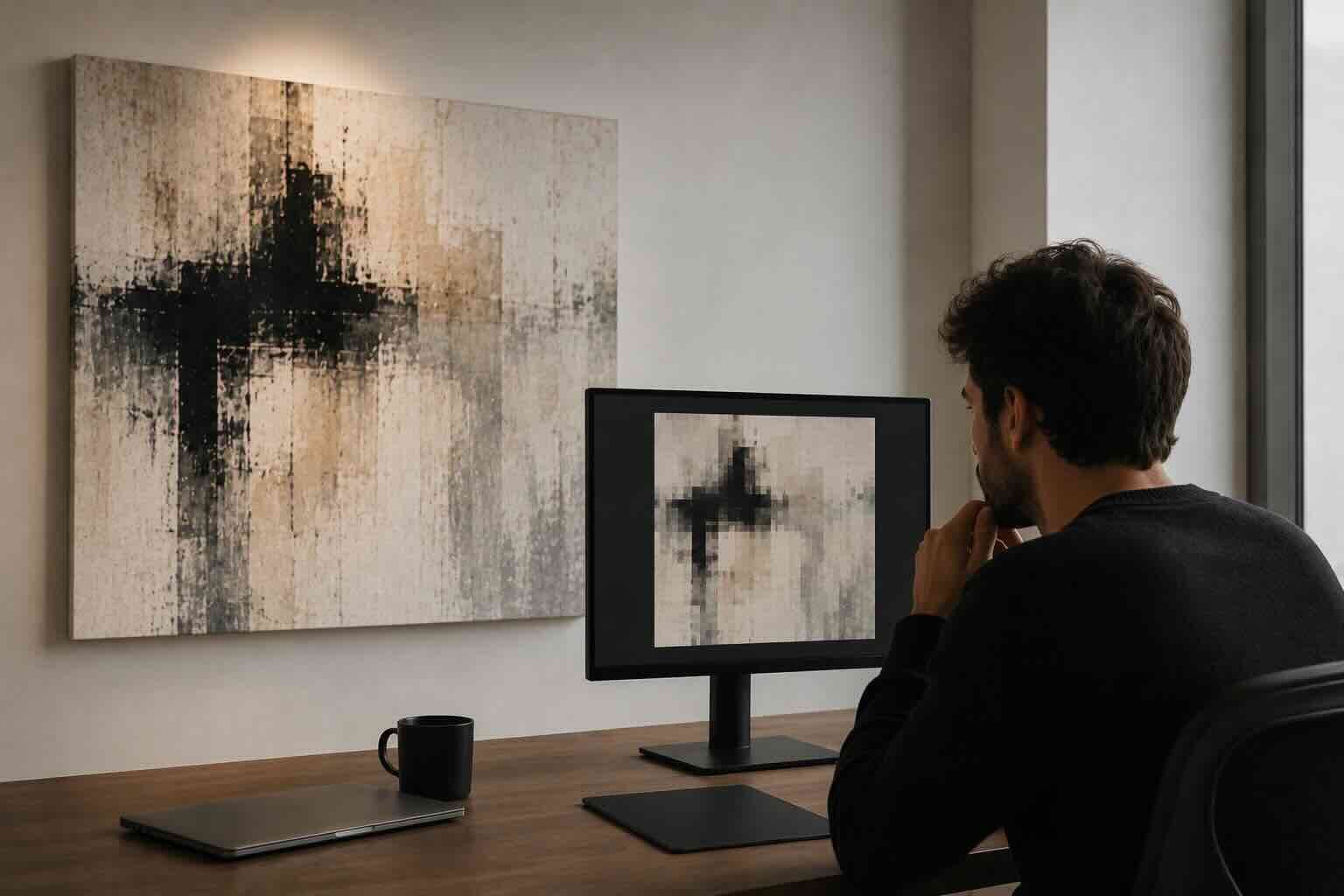
Table of Contents
- I. The flat photo is not a presentation
- II. Why 80cm+ dies on a phone
- III. Furniture is the only honest ruler
- IV. What a large canvas mockup must do
- V. Cinematic camera vs a still crop
- VI. Artlandish: imagine it in a real home
- VII. Caveats: when a flat file is still right
- FAQ
- Key Takeaways
- Sources
Key Takeaways
- In 2025, online-only art sales were $9.2 billion, 15% of a $59.6 billion market (Art Basel & UBS, Art Market Report 2026). Remote buyers still need to see scale.
- MOCKLIO's B2B filter is works ≥80 cm on at least one side. Smaller SKUs make room video look like décor ads.
- Scott at Artlandish: buyers need to imagine the piece in a real home. A flat photo does not do that job.
- Fix: photoreal hang in a collector interior, then a 10s / 12.5s camera move that reads sofa, floor, and wall run.
- Artsy's 2025 trends: 59% of collectors bought art online in 2024. Remote buyers need furniture-in-frame, not a tighter flat photo crop.
I. The flat photo Is Not a Presentation
In 2025, Art Basel and UBS put global art sales at $59.6 billion, with online-only sales at $9.2 billion, or 15% of the market (Art Basel & UBS, Art Market Report 2026). High-end value moved back toward rooms and fairs. The flat photo did not get better at selling large work. It got more common as a default thumbnail.
Conventional gallery practice still treats the square-on studio file as the honest image. It is. Registrars need it. Condition, colour, edges, and edition data live there. The mistake is shipping that file as the collector-facing hero on Instagram, the website, and the viewing-room PDF. Honesty about pigment is not honesty about size.
Why did the flat photo win? It is cheap, portable, and already in the CMS. A photographer shot it for print and insurance. Marketing inherited it. Social grids reward a clean crop. Nobody on the team is trying to lie. They are trying to publish on Tuesday.
The cost shows up later. A 150 cm painting and a 40 cm study occupy the same phone width. Price looks arbitrary. Shipping looks scary. The collector scrolls. You did not lose to a competitor's programme. You lost to a missing sofa.
MOCKLIO qualifies B2B catalogue work at ≥80 cm on at least one side for a reason. Below that threshold, room video starts to read as poster merch. Above it, the hang is the product. If your inventory is A4 prints and t-shirts, this article is not for you. If you sell large originals or large-format editions at catalogue cadence, keep reading.
II. Why 80cm+ Dies on a Phone
In the Art Basel & UBS Survey of Global Collecting 2025, 51% of HNW collectors who bought from a dealer had purchased at least one work via Instagram without viewing it in person, up from 41% in 2023 (Art Basel & UBS, Survey of Global Collecting 2025). That is the job: show scale of artwork online to people who will not walk the room this week.
A phone screen is about 15 cm tall. An 80 cm canvas is more than five times that. A 200 cm work is more than thirteen. The flat photo maps both onto the same rectangle. Your caption can shout dimensions. Most thumbs never read the caption. The eye decides first: this looks like a print you could hold in one hand.
Compression makes it worse. Instagram and WhatsApp crush fine texture. A large work's physical presence is half surface, half occupation of wall. The file keeps some of the surface. It deletes the occupation. That is why a collector can love the image and still stall on the hold.
Remote buying is not going away. Hiscox's Online Art Trade Report 2023 found 78% of surveyed buyers had purchased art online in 2022, versus 44% in 2019, and 51% said pandemic years raised their confidence in buying online (Hiscox, Online Art Trade Report 2023). Confidence without scale is still a stalled inquiry.
An 80cm+ work sold to a remote buyer is an experience product judged from a 15 cm glass. If the only asset is a floating flat photo, the buyer cannot complete the mental install. Context is not decoration. It is the missing measurement.
III. Furniture Is the Only Honest Ruler
In 2020, Brylla and Walsh showed that product images with spatial backgrounds produce more favourable evaluations, higher purchase intention, and higher willingness to pay than isolated “floating” depictions (Brylla & Walsh, “Scene Sells,” International Journal of Electronic Commerce, 2020). Art is an extreme case of that finding. The wall is the scene. The sofa is the scale bar.
What a white crop hides
White-background photography is excellent for search, insurance, and print. It is hostile to large-work sales. No skirting board. No ceiling height. No lamp. The collector has to invent a room. Most will invent a smaller one than you hung in the gallery.
What a luxury hang shows
A believable interior supplies known objects. Seat height. Table depth. Door. Headboard. Those objects are culturally stable. A large canvas mockup that places the work above a sofa at a plausible hang line does more work than another 4000px crop. Match the collector, not a student bedroom. Use luxury art mockup rooms when the programme is collector-grade, not décor-grade.
Maier and Dost (2018) found that fitting contextual backgrounds raise mental imagery and product liking for experience goods, via imagery fluency (Maier & Dost, Journal of Retailing and Consumer Services, 2018). A painting is an experience good. A flat photo on white is a search good. Stop presenting a 180 cm canvas as if it were a SKU tile.
Scale must stay honest. If the work is 85 × 120 cm, do not park it as a two-metre mural. Collectors who later see the piece in person will notice. The hang is marketing. It is also a representation. Lie about size once and the next email is harder.
IV. What a Large Canvas Mockup Must Do
A large canvas mockup is not a pretty room. It is a measurement device. It must keep the artwork file intact, set a plausible hang height, and leave enough architecture in frame that a collector can finish the sentence “that would go above the…” without a site visit. For the product surface built around that job, see large artwork mockup and art mockups.
Three tests. First: can a stranger estimate width within 20% from the still alone? If not, the room is too cropped. Second: would a director hang this in a collector interior, not a staged Etsy bedroom? If not, you are training the wrong buyer. Third: is the file the gallery's approved image, not a regenerated painting? If AI invented the art, you are done. Composite the real file.
When we look at gallery grids that “aren't converting,” the pattern is boring. Hero flat photo, dimensions in caption, maybe a detail crop. The 80cm+ pieces look identical in weight to the studies. Swap the hero to a hang with a sofa and a floor line and the comments change from “love this” to “how wide is that wall?” That question is a buying question.
Do not confuse this with replacing installation photography. An install shot documents a real show. A room hang answers a different question: how this work lives in a domestic or office interior after the crate is opened. Galleries need both. The flat photo alone is neither.
Gallery teams that already run a content stack can treat the hang as catalogue production, not a shoot day. MOCKLIO for galleries is built for that lane: upload the approved file, pick a scene, export stills and a reel. Keep the photographer for openings and people.
V. Cinematic Camera vs a Still Crop
Buffer's analysis of millions of Instagram posts found Reels reach about 2.25× as many accounts as single-image posts (Buffer, “Best Content Format on Social Platforms,” 2026). Industry summaries put Instagram Reels at roughly 200 billion daily plays. Reach is not the point for 80cm+ inventory. Motion is. A still hang can show a sofa. A camera that pulls back, pans, or eases toward the wall lets furniture enter and exit the frame. Scale becomes a sequence, not a guess.
The useful clip is short. Ten seconds at 30 fps, or a 12.5-second 24 fps remap for a more cinematic cadence. The camera should behave like a viewing-room walk, not a product zoom that sprints at the canvas and stops. That sprint is what makes cheap video look like catalogue software from another decade. Collectors need to see the room first, then the work.
A cinematic hang video is scale media. Furniture, floor, and wall run appear before the paint. The flat photo cannot sequence those references. For 80cm+ work sold to people who buy from a phone, the camera pass is not a social trend. It is the missing site visit.
Use stills where the collector needs to pause: email, PDP, price list, WhatsApp follow-up. Use the reel where the algorithm and the eye need motion: Instagram, Stories, fair teaser, viewing-room header. One artwork file should produce both. If your “video strategy” is a photographer walking toward the painting once a quarter, you do not have a catalogue system.
For the operating model around batch hangs, reels, and captions, use art gallery marketing software. The point is cadence across 25–100 works, not a prettier flat photo.
VI. Artlandish: Imagine It in a Real Home
Artlandish Aboriginal Art Gallery runs a large catalogue of originals. Presentation is not a side hobby. Scott, the director, put the buyer job in one sentence: buyers need to imagine how a piece will look in a real home or interior space. Static product photos matter. They only go so far. That is the entire 80cm+ argument, from a gallery that actually sells at volume.
He was not asking for a growth hack. He was asking for a presentation layer that does not look cheap or template-driven. The alternative, in his words, is hiring a photographer, videographer, editor, interior stylist, or 3D artist. Most catalogues cannot staff that for every SKU, every week. The flat photo remains because production is the bottleneck, not taste.
He needed a presentation layer that did not look cheap or template-driven. "You upload the artwork, choose the scene, and Mockl.io does the heavy lifting." That is the operational proof that the visual argument can be executed at catalogue speed. Read the full story on the Artlandish Aboriginal Art Gallery page. Do not borrow the quotes for a fake “we work with every famous gallery” claim. One named director is enough.
The psychology is loss aversion. An unsold large work sitting as a flat photo is a crate that never gets mentally installed. Contrast is the fix: flat file, then hung file, then moving camera. Hick's law for the CTA: one next step, not a feature tour. Start a catalogue trial with ten of your 80cm+ files, or book the Gallery plan walkthrough. Do not send this buyer to a $19 artist seat.
VII. Caveats: When a Flat File Is Still Right
Keep the square-on flat photo. Always. Condition, colour accuracy, and scholarship depend on it. A room hang that hides edges or invents a frame you do not sell is worse than a floating file. Label mockups as presentation when your audience is institutional or when a journalist might treat the still as an install photo.
Small works can stay on white. A 30 cm drawing does not need a villa living room. That hang looks like a lie. Sculpture, highly reflective metal, and work whose value is in the round still need real photography. CGI rooms solve wall-based scale. They do not replace a turntable or a conservator's light.
If your buyers only purchase after a private view in the space, the flat photo-plus-hang stack is still useful for the 51% Instagram path and for the collector who wants a spouse to see the wall. It will not close a seven-figure negotiation by itself. Do not pretend otherwise.
Related Guides
FAQ
Why do large canvases look small as flat photos?
A phone maps every work to the same rectangle. An 80 cm canvas and a 30 cm study occupy identical pixels. In 2025, 51% of dealer-buying HNW collectors in the Art Basel & UBS collecting survey had bought via Instagram without an in-person view. Without furniture in frame, they have no ruler.
What size of artwork needs a room hang online?
Treat ~80 cm on at least one side as the line. Below that, room video often reads as décor. Above it, scale is the sales problem. MOCKLIO's B2B filter uses that threshold. If you sell A4 posters, stay on print-shop workflows. If you sell large originals, hang them.
Does a large canvas mockup replace installation photography?
No. Installation photos document a real exhibition. A large canvas mockup answers domestic or office placement for remote buyers. Brylla and Walsh (2020) found spatial backgrounds beat isolated product shots on purchase intention. Use both. Do not pass a CGI hang as an archival install.
Why add cinematic video if the still hang already shows a sofa?
Motion sequences the ruler. A pullback lets the wall run and furniture enter the shot. Buffer's 2026 format data puts Reels at about 2.25× the reach of single images, which is how many collectors first meet the work. The still remains the email and PDP asset.
How should a gallery start if the catalogue is all flat photos today?
Pick ten available works ≥80 cm. Generate one luxury hang and one 10-second reel per file. Put the hang on the artwork page and the reel on Instagram. Artlandish used catalogue files rather than a hire for a 40-video burst. Start a Gallery plan catalogue trial rather than a Pro artist account.
Key Takeaways
- flat photos keep colour. They delete occupation of the wall.
- 80cm+ inventory needs furniture-in-frame, not a tighter crop.
- Luxury collector rooms beat décor bedrooms for this ICP.
- Cinematic camera is a scale sequence; stills are the pause layer.
- Artlandish: imagine the piece in a real home, then batch the catalogue.
Conclusion
Large works die as flat photos because phones erase size. The industry default is still a floating file because it is already in the database. That default is expensive when the work is 80 cm or more and the buyer is on Instagram. Hang the piece in a real interior. Move the camera so furniture does the measuring. Keep the studio flat photo for truth. Stop asking it to sell scale.
Upload ten large files. Compare the thumbnail to the hang. If the hang does not change the conversation, your rooms are wrong or your scale is dishonest. If it does, you have the catalogue system. Start a catalogue trial, read how Artlandish presents the catalogue, then use art gallery marketing software as the hub.
- MOCKLIO Team
Sources
- Art Basel & UBS, The Art Market Report 2026, retrieved 2026-10-03, artbasel.com
- Art Basel & UBS, Survey of Global Collecting 2025, retrieved 2026-10-03, artbasel.com
- Hiscox, Online Art Trade Report 2023, retrieved 2026-10-03, hiscox.co.uk
- Brylla, D., & Walsh, G., “Scene Sells: Why Spatial Backgrounds Outperform Isolated Product Depictions Online,” International Journal of Electronic Commerce, 2020, retrieved 2026-10-03, doi.org/10.1080/10864415.2020.1806470
- Maier, E., & Dost, F., “Fluent contextual image backgrounds enhance mental imagery and evaluations of experience products,” Journal of Retailing and Consumer Services, 2018, retrieved 2026-10-03, doi.org/10.1016/j.jretconser.2018.09.006
- Artsy, Art Market Trends 2025, retrieved 2026-10-03, artsy.net
- Buffer, Best Content Format on Social Platforms in 2026, retrieved 2026-10-03, buffer.com