Fine Art Print Retailers: Room Video on Hero SKUs
Last updated: October 3, 2026
Fine-art print retailers: unlimited room stills for the catalog; cinematic room video on hero SKUs for PDP and ads. Giclée and limited editions, not POD.
Posted by
 Basti
Related reading
How to Make an Art Carousel Without Canva
Build an Instagram art carousel from the same room scene as your Reel. No Canva templates. MOCKLIO auto-builds slides and writes the caption.
How to Batch Create Art Content for a Drop
Drop a whole series at once: upload up to 50 artworks, let AI pick a room for each piece, then ship Reels, carousels, and captions together.
Instagram Captions That Sell Art (With Examples)
Captions that sell art name size, room, and where to buy. MOCKLIO writes a Reel caption and a carousel caption for the piece, ready to paste.
Short answer: Fine art print retailers should put cinematic room video on every hero SKU (the editions that carry paid ads, homepage tiles, and the product-detail page) and keep unlimited photoreal stills on the rest of the catalog. That split fits giclée and limited-edition programmes, not POD merch. MOCKLIO composites the print-ready file into handcrafted rooms: 10s at 30fps and 12.5s at 24fps, 16:9 or 9:16. Stills stay unlimited on volume plans; video credits go where AOV and traffic justify them.
Key Takeaways
- Hero SKU = PDP + ads. Long-tail SKUs get room stills. Do not videograph the entire catalog.
- Unlimited stills on Atelier ($179/mo, 25 videos) and Gallery ($299/mo, 50 videos). Need more volume? Contact us at contact@mockl.io.
- This is not bulk art mockups for Etsy sellers. Large giclée / limited editions, collector interiors, 80cm+ scale.
- Artwork is composited, not regenerated. Same file you print.
- Scott Linklater at Artlandish: buyers need to imagine the piece in a real home. Static product photos only go so far.
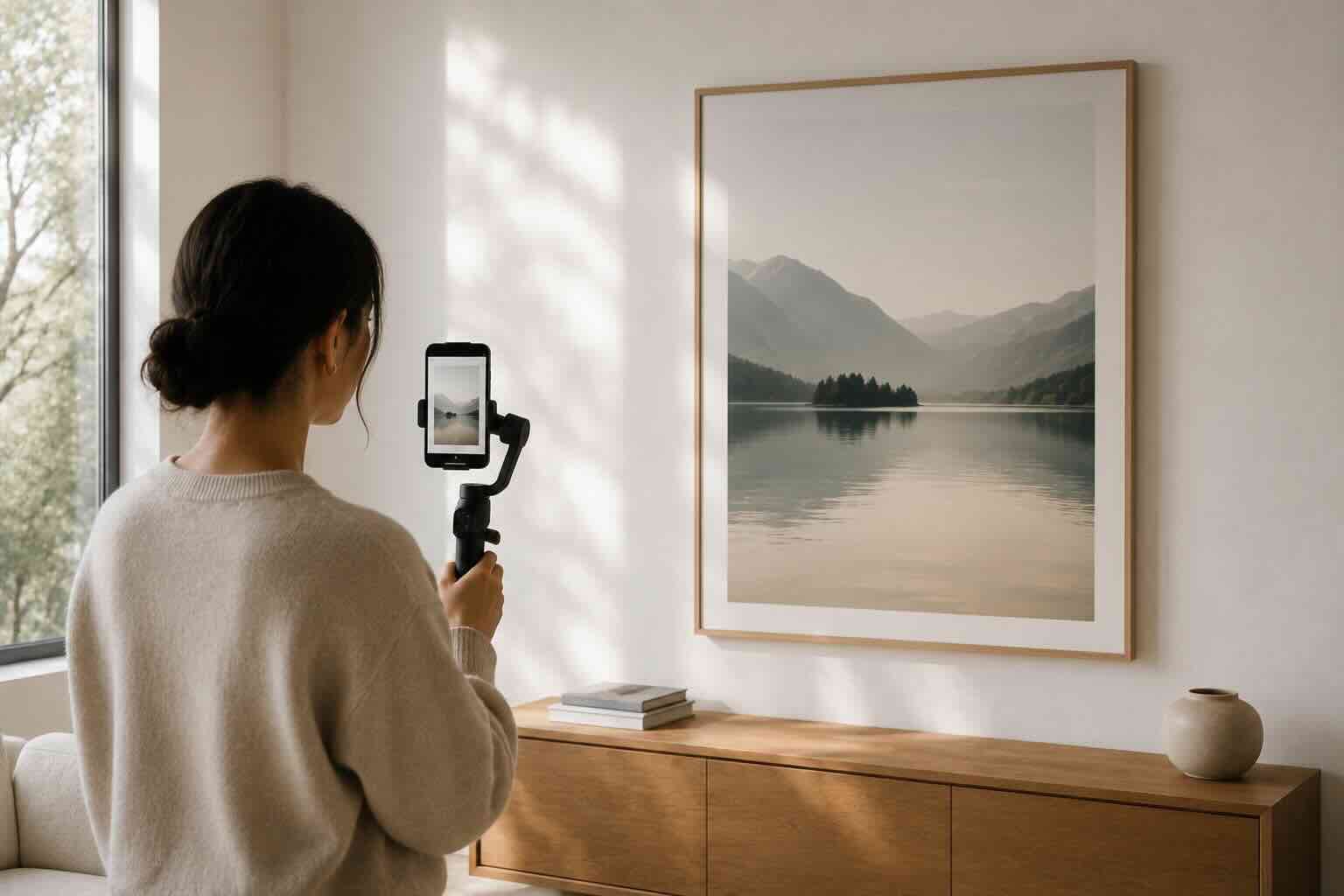
Table of Contents
- I. Put room video on the hero SKU, not every SKU
- II. Why a print PDP still dies as a flat photo
- III. Unlimited stills for the catalog; video credits on heroes
- IV. PDP and ads share one hang
- V. Giclée and limited editions are not POD merch
- VI. How to pick heroes, rooms, and scale
- FAQ
- Key Takeaways
- Conclusion
I. Put Room Video on the Hero SKU, Not Every SKU
A fine-art print retailer does not need a cinematic reel on every SKU. Put room video on the hero SKU: the edition that sits on the homepage, in paid social, in the weekly email, and on the PDP that paid traffic lands on. Everything else in the catalog gets photoreal stills so scale and wall context exist without burning video credits.
Ecommerce teams at photography-print and giclée retailers already know this split from still photography. You do not book a lifestyle shoot for 4,000 SKUs. You shoot the campaign set, then fill the catalog with a repeatable packshot. Room CGI is the same economics with a better output: unlimited stills, video only where it changes the click.
A hero SKU is not “whatever is in stock.” It is the SKU with enough margin, search demand, or brand weight to carry a 10-second hang. New drops, signed limited editions, oversized photography prints, and the three tiles that eat ad spend. If the SKU cannot justify a video credit, it is catalog, not campaign.
MOCKLIO is built for that mix. Upload the print-ready file, pick a collector interior, export stills for every size variant, then spend a video credit only on the hero. Batch AI can match rooms across a drop of up to 100 files when you are filling stills. Video stays selective. See MOCKLIO for fine art print shops for the shop-side workflow. Stills and reels share the same scenes on art mockups.
II. Why a Print PDP Still Dies as a Flat Photo
A print product-detail page dies as a flat photo because the buyer cannot feel scale, paper, or wall presence from a crop on white. Scott Linklater, Owner/Founder of Artlandish Aboriginal Art Gallery, put it without startup language: buyers need to imagine how a piece will look in a real home. Static product photos are important, but they only go so far.
Print retail has the same remote-buyer problem as a catalogue gallery, with more SKUs. The shopper is not standing in your showroom. They are on a phone, comparing a 70×100 cm giclée to a sofa they cannot see. Dimensions in a spec table do not fix that. A photoreal hang does. A slow camera through a believable interior does it again. Artsy's 2025 trends survey found 59% of collectors bought art online in 2024 (Artsy art market trends 2025). Maier and Dost (2018) show contextual backgrounds raise purchase intention for experience goods (Maier & Dost, 2018). Hero PDPs with video convert about 80–86% better than static-only heroes in 2026 commerce benchmarks (DigitalApplied).
Lifestyle photography used to be the answer at this price point. It still is for people, unboxings, and paper-texture close-ups. It fails as a catalog system: new editions every week, size variants, frame SKUs, seasonal ad sets. You cannot restage a penthouse for each drop. CGI rooms exist so the file you already print can hang without a set day.
The artwork is not invented. MOCKLIO composites the uploaded file into a handcrafted room. Light, shadow, and camera motion are simulated. The print is the print. That matters for limited editions: the collector is buying a specific image, not an AI reinterpretation. Full case: Artlandish Aboriginal Art Gallery.
III. Unlimited Stills for the Catalog; Video Credits on Heroes
Volume plans treat stills and video as two different jobs. Stills are unlimited so every listed edition can show wall context. Video is a credit: Atelier at $179/month for 25 cinematic videos, Gallery at $299/month for 50 (about $5.48 per video on yearly). Need more volume? Contact us at contact@mockl.io.
That is the money model for a print retailer, not a $19 artist seat. Catalog photography was never the expensive line. Motion was. A videographer plus editor plus interior for one campaign SKU is a day rate. Fifty hero SKUs in a month is a hire. Gallery volume is the in-house studio for the SKUs that actually need motion.
| Asset | Where it lives | MOCKLIO economics |
|---|---|---|
| Photoreal room stills (multi-angle) | Every PDP, size variant, PLP tile, email | Unlimited on volume plans |
| 10s @ 30fps reel (9:16) | Hero PDP, Reels, paid social | One video credit |
| 12.5s @ 24fps cinematic (16:9) | Hero PDP, site hero, YouTube, email embed | Same job / content pack |
| Carousel + captions | Organic drop posts, Stories | Content pack with the job |
One job should return a content pack: 10s, 12.5s, three stills, carousel, caption carousel, caption reel. The ecommerce lead does not re-export in CapCut. The ad account and the PDP pull from the same hang. Implementation detail lives on print shop mockup software.
Scott’s public note is the same ops problem at SKU scale: no photography set-up, no videography, no editing software: upload, choose the scene, Mockl.io does the heavy lifting. You do not want a freelancer queue between the drop file and the PDP. Start a catalogue trial on ten hero files, not a Pro signup.
IV. PDP and Ads Share One Hang
Paid social for a print retailer fails when the ad shows a styled room and the PDP shows a flat photo on grey. The hang has to be the same object: same file, same scale, same interior language. Room video on the hero SKU is the bridge. The ad earns the stop. The PDP continues the same interior instead of dumping the shopper into a spec sheet.
Use 9:16 on Reels, Stories, and most paid placements. Use 16:9 on the PDP player, homepage modules, and email. Both lengths come from the same scene. Do not run a generative clip in the ad and a Photoshop composite on the site. Collectors notice when the sofa changes and the print does not.
Keep paper-truth assets next to the hang. The room video sells presence. A crop of the print, a frame/finish swatch, and edition facts sell the object. CGI is not a substitute for a detail shot of rag paper or a certificate. It is the missing middle between thumbnail and checkout.
Ecommerce mockups at SKU scale (PDP galleries, size variants, campaign ads) are the job of fine art print ecommerce mockups. That page is the product spoke. This article is the ops rule: video on heroes, stills on the long tail, one hang language across channels.
V. Giclée and Limited Editions Are Not POD Merch
Fine-art print retail is giclée, pigment, photography editions, and signed limited runs, often 80cm+ on one side. It is not a POD t-shirt shop and it is not an A4 Etsy poster mill. If the work reads as décor merchandise, room video looks like a furniture ad. If the work is large and editioned, the room has to look like a collector interior.
That is why this piece is distinct from bulk art mockups for Etsy sellers. Etsy bulk is listing volume for independent sellers. Print retail is a catalog operator: thousands of SKUs, a merchandising calendar, paid media, and a brand that cannot look like a bedroom template. Same software family. Different buyer, rooms, and CTA.
Qualification we use internally: volume of at least 25 originals or fine-art prints listed or sold per month, and works around 80cm+ on one side. Below that, a Pro artist workflow is enough. At catalog cadence, you are hiring MOCKLIO to replace a videographer-plus-intern queue, not to “grow as an artist.”
Inventory CRM is a different product. Room visualization does not replace your PIM, Magento/Shopify catalog, or datafeed. Many operators keep a rooms/CRM tool for placement widgets and use MOCKLIO for presentation that sells. Do not rip out the feed to get a reel. Hang the file. Leave stock status where it already lives.
VI. How to Pick Heroes, Rooms, and Scale
Pick heroes from traffic and margin, not from whoever emailed the studio last. Last month's top 20 PDPs, this week's drop, anything in a paid set, anything oversized. Cap video at your plan (25 or 50). Fill every other live SKU with stills so the catalog never looks like a white void next to the campaign.
Room choice is merchandising. A large photography print wants architecture and negative space, not a cluttered bed-in-a-box set. A color-field giclée can sit above a sofa if the sofa is not the product. Scale must stay honest: if the edition is 50×70 cm, do not hang it as a two-metre mural. Credibility is the whole point of CGI for this buyer.
Source files should be the print-ready flat, square-on, full bleed, no room already baked in. Do not upload a previous lifestyle photo and ask the system to “fix” it. Variant SKUs (size, frame) can share one scene with corrected scale rather than a new video each. Spend the extra credit when the frame actually changes the object.
Batch stills around a drop the way a gallery batches an opening. Artlandish uses MOCKLIO because the system does the heavy lifting. A print retailer can run a drop of hero stills plus a handful of reels the same afternoon. Hub context: art gallery marketing software and MOCKLIO for galleries. Print ops sit in the same cluster, different SKU math.
Related Guides
FAQ
Should every print SKU have a cinematic room video?
No. Put room video on hero SKUs that carry PDP traffic and ads. Cover the rest of the catalog with unlimited photoreal stills so every listed edition shows scale. Atelier is 25 videos/month; Gallery is 50. Burning credits on long-tail posters wastes the plan. Heroes get motion; the catalog gets walls.
How is this different from bulk mockups for Etsy sellers?
Etsy bulk is listing volume for independent sellers and small posters. Fine-art print retail is giclée and limited editions, often 80cm+, merchandised like a catalog brand. Rooms should read as collector interiors. CTA is Atelier/Gallery, not a $19 Pro artist seat. See bulk art mockups for Etsy sellers only if that is actually your shop.
Does MOCKLIO regenerate or invent the giclée?
No. The print-ready file is composited into a handcrafted CGI room. AI may help match a scene; it does not paint a new artwork. Limited editions stay the edition. If the file is wrong, the hang is wrong: fix color and crop upstream, the same as a press proof.
Which MOCKLIO plan fits a fine-art print retailer?
Atelier at $179/month if you video about 25 heroes. Gallery at $299/month for 50, about $5.48 per video yearly, with unlimited stills. Need more volume? Contact us at contact@mockl.io. Do not close this buyer on Pro. Start a Gallery plan trial or review pricing.
Can we use stills on the PDP and video only in ads?
You can, but the hang should match. An ad that shows a cinematic room and a PDP that shows a flat photo is a trust drop. Better: stills on every SKU, 10s/12.5s on the hero PDP player, same scene in the ad account. Paper crops and edition facts stay next to the hang. Motion is the hero layer, not a bait-and-switch.
Key Takeaways
- Room video on every hero SKU; unlimited stills on the catalog.
- PDP and ads must share one photoreal hang, two aspect ratios.
- Giclée / limited edition / 80cm+, not POD merch or Etsy bulk.
- Atelier $179 / Gallery $299. Need more volume? Contact us at contact@mockl.io. Stills unlimited. Video is the scarce credit.
- Hung from the artwork they uploaded. Not a CRM. Not a press replacement.
Conclusion
Fine-art print retailers already know how to print. The gap is showing a remote buyer a large edition in a room without a production crew. Put cinematic room video on every hero SKU. Cover the catalog with stills. Keep the hang consistent from ad to PDP.
Upload ten campaign files. Get Share Packs back. If 25 or 50 videos a month is the real constraint, that is Atelier or Gallery. Need more volume? Contact us at contact@mockl.io. Book a catalogue trial.
- MOCKLIO Team
Sources
- Artsy, Art Market Trends 2025, retrieved 2026-10-03, artsy.net
- Maier, E., & Dost, F., Journal of Retailing and Consumer Services, 2018, retrieved 2026-10-03, doi.org/10.1016/j.jretconser.2018.09.006
- DigitalApplied, Video marketing statistics 2026, retrieved 2026-10-03, digitalapplied.com