How Artists Can Create Gallery-Level Art Reels in 10 Minutes (2026)
Last updated: July 4, 2026
Step-by-step guide to create cinematic art reels in 10 minutes without editing skills. Use faster video content to increase reach and buyer interest.
Posted by
 Basti
BastiRelated reading
Best Tools to Promote Contemporary Art Exhibitions Online (2026)
Promote contemporary art exhibitions online: Meta ads, email, Instagram, PR. Pair paid reach with MOCKLIO room stills and cinematic reels so the show looks owned before opening night.
Commercial Gallery Instagram: Catalogue vs Opening
Split commercial gallery Instagram into MOCKLIO catalogue hangs and real opening footage. One roster cadence across locations; camera stays for people.
How Galleries Create Instagram Content Without a Videographer
Gallery Instagram without a videographer: batch MOCKLIO cinematic reels from artwork photos, keep event filming for openings, and scale with Atelier or Gallery plans.
Answer-First Block
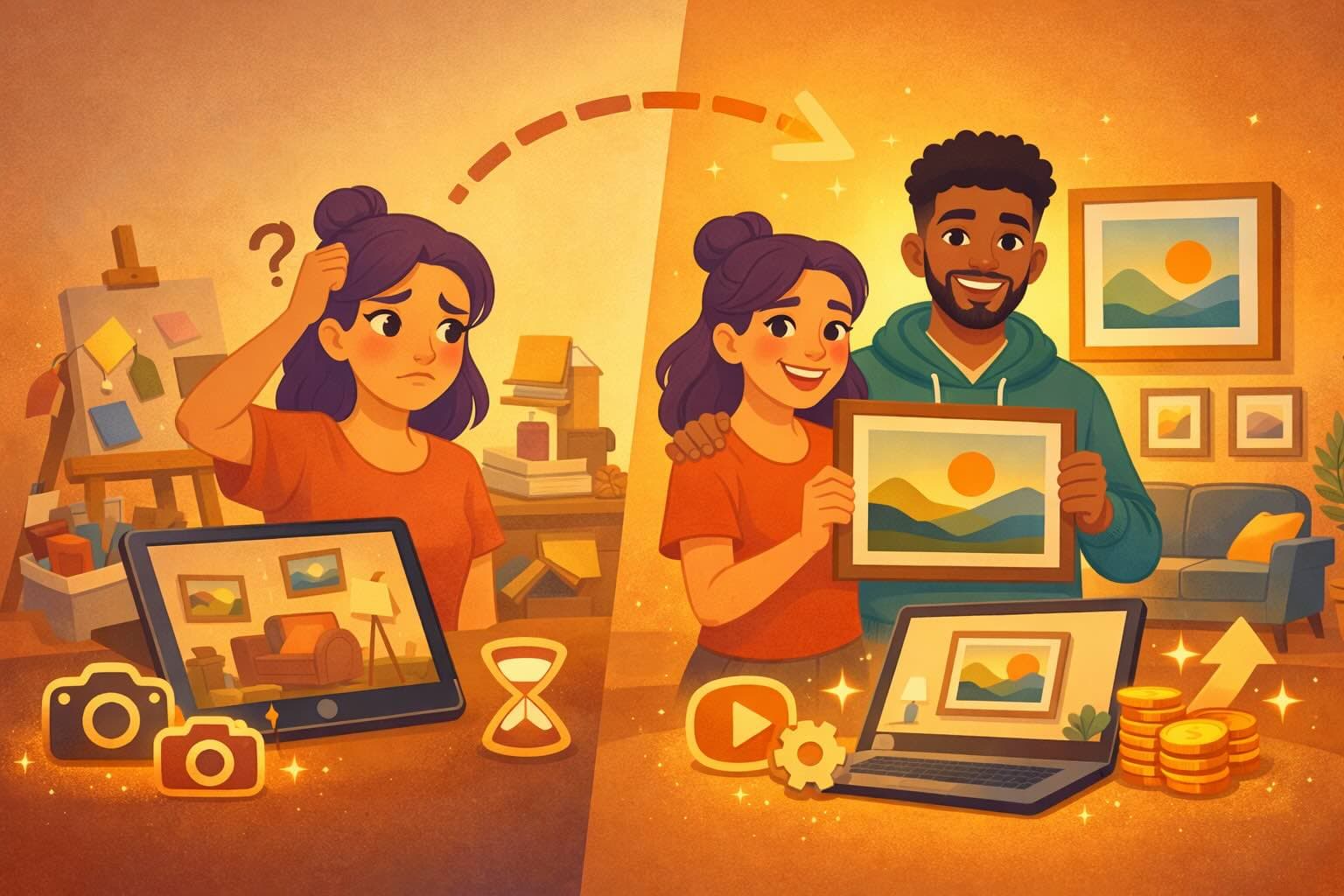
Quick Answer:Creating professional Instagram reels for artists doesn't require video editing expertise or expensive software. A gallery-level art reel uses realistic room mockups, smooth transitions, and cinematic pacing to show your artwork in context - making buyers visualize ownership instead of squinting at a flat photo. With the right approach, you can create art promo videos in under 10 minutes that increase perceived value and convert browsers into buyers.
How to Create Gallery-Level Art Reels in 10 Minutes (No Editing Skills Required)
Most art reels look like amateur slideshows with trending audio slapped on top. Here's how to create cinematic art promo videos that make buyers stop scrolling and start trusting your price point.
Table of Contents
- I. Why Most Art Reels Tank Your Perceived Value
- II. The Psychology of Cinematic Art Reels
- III. The 10-Minute Art Reel Protocol
- IV. Common Objections (and Why They're Wrong)
- V. The Weekly Drop Loop
- Key Takeaways
- Comparison Table
- FAQ
- Conclusion
I. Why Most Art Reels Tank Your Perceived Value
Your art reel is killing your sales.
Not because your art is bad - because your presentation makes a $300 print look like a $30 poster. You're shooting flat photos of your work against a white wall, throwing them into a template with a trending audio track, and wondering why people double-tap but don't buy. The mechanism here is brutal: buyers can't visualize ownership, so they treat your work as disposable content instead of investment-worthy art.
Instagram reels for artists should function as virtual gallery visits, not slideshows. When someone scrolls past your reel, they need to see your painting above a credenza in a sun-lit living room - not taped to your studio wall with masking tape visible in the corner. The difference isn't vanity. It's conversion psychology.
Here's what happens in the buyer's brain:
- Flat photo of artwork- "That's nice" - scroll - forget
- Artwork in a styled room setting- "I can see that in my home" - profile click - price check - DM
That mental simulation is the entire game.
I watched an abstract painter on Etsy - selling prints in the $80-$150 range - switch from posting studio photos to posting art reels with gallery-style mockups. Her Reel views stayed roughly the same (around 5-8k per post). But her DM inquiries tripled in the first month, and her conversion rate from inquiry to sale jumped from about 15% to 40%. Why? Because buyers could finally see it on their wall. They weren't buying paint on canvas anymore. They were buying the feeling of walking into their apartment and seeing something beautiful they chose.
But here's the cruel part: creating those cinematic art reels used to require Premiere Pro skills, After Effects knowledge, or hiring a video editor for $200+ per project. Most artists don't have the time, the budget, or the patience to learn motion graphics for a single weekly post.
The gap between "what works" and "what's realistic" is where most artists stay stuck.
There's nuance here - you don't need Hollywood-level production. But you do need more than a Canva slideshow with Ken Burns zoom. You need mockups that look real, transitions that feel intentional, and pacing that holds attention for 7-15 seconds (the magic window for Instagram engagement + memory encoding).
Now let's break down why gallery-level art reels work - and then how to make them without becoming a video editor.
II. The Psychology of Cinematic Art Reels
People don't buy art. They buy the version of themselves who owns that art.
This is the core mechanism behind why cinematic reels convert better than static posts. When someone sees your painting mounted in a beautifully lit gallery mockup or floating above a minimalist console table, their brain doesn't process "art" - it processes context. And context triggers aspiration, which triggers buying intent.
Let's get specific. A cinematic art reel works because it hits three psychological levers:
1. Spatial Anchoring (the "I can see it" effect)
Buyers need to mentally place your artwork somewhere. A flat product photo gives them nothing. A room mockup gives them a reference frame: "That's a medium-sized piece, it would fit above my couch, the colors work with my throw pillows." You're not asking them to imagine anymore - you're showing them the answer.
2. Perceived Value Through Production Quality
Whether fair or not, buyers equate presentation quality with product quality. An artist who posts clean, cinematic reels signals professionalism, attention to detail, and investment-worthiness. The exact same painting shown in a shaky iPhone video with bad lighting reads as "hobby artist." Shown in a smooth art promo video with a gallery mockup? Reads as "emerging professional."
This is the same reason high-end restaurants photograph food on white plates with soft lighting. The food might taste identical to the diner version - but the trust signal is different.
3. Frictionless Decision-Making
Buying art online is high-friction. Buyers worry: "Will this look cheap in person? Is the size right? Will it clash with my decor?" A well-executed art reel answers all three questions in 10 seconds. Size becomes clear through context. Quality is implied through presentation. Style-fit is demonstrated through the mockup aesthetic.
You're not manipulating anyone. You're removing the cognitive load that prevents purchase.
Take Sarah, a watercolor artist selling originals in the $400-$1,200 range via Instagram DMs. She used to post process videos (painting time-lapses) and got decent engagement - 10-15k views, lots of comments like "so talented!" But sales stayed flat. Then she switched to posting weekly art reels: 10-second videos showing her finished paintings in 2-3 different gallery mockups with subtle zoom transitions and a lo-fi music bed.
Her views dropped slightly (8-12k average), but her DM inquiries went from 2-3 per week to 10-15. Conversion improved because buyers were pre-qualified. They'd already seen the piece in a room. They knew it worked. The DM was about logistics, not convincing.
The reel did the selling. The DM closed the logistics.
Here's the framework for a conversion-optimized art reel structure:
- Hook frame (0-2 seconds): Show the artwork in the most striking mockup (gallery wall or dramatic interior)
- Context shift (3-6 seconds): Transition to a second mockup (different room style or angle)
- Detail emphasis (7-10 seconds): Close-up of artwork texture or signature (optional but powerful)
- End card (11-13 seconds):Your handle + "DM to purchase" or "Link in bio"
That's it. No complex storytelling. No trending dance moves. Just spatial context + professional presentation.
Now - how do you actually make this if you're not a video editor?
III. The 10-Minute Art Reel Protocol
Here's the blunt truth: most artists spend 40 hours creating a painting, then give it 4 minutes of presentation effort. That's backwards.
You don't need to become a video editor. You need a repeatable system that produces gallery-level output in the time it takes to drink a coffee. This is the protocol I recommend for artists shipping a weekly drop - whether you're posting a new original, a print release, or a limited edition.
The 10-Minute Reel System (Step-by-Step)
Step 1: Shoot your artwork (2 minutes)Take one clean, well-lit photo of your finished piece. Natural light near a window, phone camera, straight-on angle. You don't need a DSLR. You need even lighting and a non-distracting background. If you're photographing a canvas, prop it against a wall or easel. If it's a print, lay it flat on a neutral surface.
Step 2: Generate 2-3 gallery mockups (3 minutes) Upload your artwork photo to a mockup generator that produces realistic room scenes. You want mockups that feel inhabited - not sterile Ikea catalog shots. Look for soft shadows, realistic lighting, and furniture that reads as "curated home" not "staged photo shoot."
The difference between a Canva template mockup and a gallery-level mockup is physics. Good mockups have proper perspective distortion, lighting that matches the room, and subtle reflections if there's glass framing. Cheap mockups look like someone cut-and-pasted a rectangle onto a stock photo.
Step 3: Assemble the video (4 minutes) Import your mockups into a video tool. Use simple crossfade transitions (0.5-1 second duration). Set each mockup to display for 3-4 seconds. Add a subtle zoom (5-10% scale over the duration of the clip) to create motion. Choose a music bed - lo-fi, ambient, or minimal piano works best. Avoid trendy pop tracks unless your brand is playful.
Export at 1080x1920 (vertical), 30fps minimum. Instagram compresses everything, so don't stress about 4K.
Step 4: Add captions + CTA (1 minute)Write a short caption hook: "New drop: [Title] - [Size] - [Price]" or "[Medium] study exploring [theme]." Add "DM to purchase" or "Link in bio for prints." Keep it simple. The reel is the hook. The caption is the conversion path.
Total time: 10 minutes. Less if you batch multiple reels in one sitting.
What This Looks Like in Practice
Let's say you're releasing a new abstract print ($120, 16x20) on Monday. You follow this system every Sunday evening:
- 6:00 PM: Photograph the print (flat lay, window light)
- 6:02 PM: Upload to mockup generator, select 3 room styles (modern living room, minimalist bedroom, gallery wall)
- 6:05 PM: Download mockups, import into video app
- 6:06 PM: Add crossfades, 8% zoom, choose music track
- 6:09 PM: Export, upload to Instagram as draft
- 6:10 PM: Write caption, schedule for Monday 9 AM
You've just created a cinematic art reel that would've cost $150-$300 to outsource. And because it's a system, you can repeat it every single week without creative burnout.
Now here's where most artists fail: they do this once, get excited, then ghost for three weeks.
The power isn't in one viral reel. It's in the compounding effect of weekly visibility + weekly proof of output. Buyers need to see you shipping consistently before they trust you with $200-$2,000.
If you want a tool that condenses Steps 2-3 into a single click, MOCKLIO is built exactly for this loop - upload your artwork, generate gallery mockups + a cinematic reel, publish. It's designed for artists who need to ship weekly, not just "someday."
IV. Common Objections (and Why They're Wrong)
Let's address the reasons you think this won't work for you.
"My art isn't polished enough for this kind of presentation"
Wrong frame. Presentation doesn't require your art to be "polished." It requires your art to be finished. If you're willing to post a painting to Instagram, you're claiming it's done. So present it like you mean it. A gallery-level reel doesn't make amateur art look professional - it makes finished art look valued. If your work isn't ready, don't post it. But if it is ready, stop underselling it with bad presentation.
"I don't have time to make a video every week"
You have time to scroll Instagram for 20 minutes a day. You have time for a 10-minute reel system. This is a priority problem, not a time problem. And if you genuinely can't carve out 10 minutes on a Sunday, you're not serious about selling. That's fine - but don't pretend the issue is time.
"Won't mockups make my art look fake or overhyped?"
Only if the mockups are bad. A realistic gallery mockup doesn't overhype - it contextualizes. Buyers expect to see art on a wall. You're giving them what they already want. The issue is when mockups look Photoshopped (bad shadows, wrong perspective, sterile backgrounds). Use high-quality mockup generators that simulate real rooms with real lighting. The goal is "believable," not "aspirational fantasy."
"I'm not trying to be an influencer, I just want to sell art"
Great. Then stop treating Instagram reels like influencer content. You're not dancing or doing trends. You're showing your product in a professional format so buyers can make an informed decision. This is the same as a furniture brand posting a video of a chair in a living room. It's product marketing, not performance art.
"What if I post consistently and still don't get sales?"
Then your problem isn't presentation - it's offer, pricing, or audience. But you can't diagnose that until you remove presentation as a variable. Most artists never find out what's actually broken because they're stuck in "bad content - no sales - inconsistent posting - bad content" loops. Fix the system first. Ship weekly for 8-12 weeks with proper presentation. Then you'll know what needs adjusting.
There's nuance here - cinematic reels aren't a magic bullet. If your audience is "people who like art" (too broad), or your pricing is misaligned with your skill level, or your DM close rate is 5% because you're not following up, reels won't save you. But they will surface those issues faster by giving you clean data. And for most artists, presentation is the blocker.
V. The Weekly Drop Loop
The artists who win on Instagram in 2026 aren't the ones posting sporadically when inspiration strikes. They're the ones treating content like a weekly sales cycle.
Here's the loop:
- Monday (9 AM): Post your art reel (new piece, new mockup set, clean presentation)
- Monday-Wednesday: Engage with comments, reply to DMs, answer inquiries
- Thursday: Post a secondary piece of content (studio shot, process clip, or testimonial repost)
- Friday-Sunday: Create next week's reel, photograph new work, batch mockups
This rhythm does three things:
- Trains your audience to expect weekly drops (they check your profile more often)
- Gives you a feedback loop (you see what mockup styles or art themes get DMs)
- Builds proof of consistency (buyers trust artists who ship, not artists who vanish)
Think of it like a video game quest loop. Every Monday is a "new drop" - you've got a week to convert the attention into sales, then you reset and drop again. The gamification isn't cringe if it keeps you consistent.
An oil painter I know - selling originals in the $800-$3k range - adopted this exact loop in mid-2025. She committed to 12 consecutive weeks of Monday art reels (cinematic mockups, same music style, consistent branding). By week 6, she was getting 15-25 DM inquiries per drop. By week 10, she had a waitlist for commissions. The art quality didn't change. The consistency + presentation did.
The system sells. Not the one-off viral moment.
And if you need to condense the "create reel" step from 10 minutes to 2 minutes, that's where a tool like MOCKLIO becomes less of a nice-to-have and more of a sales infrastructure decision. You're not paying for a mockup generator - you're paying to remove the friction between "I finished a painting" and "I published a sales-ready reel."
Key Takeaways
- Instagram reels for artists work when they simulate gallery context, not when they're slideshows with trending audio. Buyers need spatial anchoring to visualize ownership.
- Cinematic reels convert better because they reduce friction, signal professionalism, and trigger aspiration. Presentation quality equals perceived product quality in the buyer's brain.
- You can create gallery-level art promo videos in 10 minutes using a repeatable system: photograph artwork, generate realistic mockups, assemble video with simple transitions, publish with a clear CTA.
- Consistency beats virality. A weekly drop loop trains your audience, builds trust, and surfaces real conversion data faster than sporadic posting.
- The biggest objection - "I don't have time" - is a priority problem, not a logistics problem. If you can't invest 10 minutes a week in presentation, you're not optimizing for sales.
- Mockups don't overhype your art if they're realistic. They contextualize it. Buyers expect to see art on a wall. You're removing guesswork, not manipulating perception.
- The system is the asset, not the individual reel. Build a repeatable protocol, ship weekly, iterate based on DM volume and conversion rate. This is video marketing for artists that compounds and turns each reel into an Instagram video for art sales.
Comparison Table: Art Reel Creation Methods
| Method | Time per Reel | Skill Required | Output Quality | Cost | Best For |
|---|---|---|---|---|---|
| DIY (Canva slideshow) | 15-30 min | Low | Amateur (flat, templated) | Free-$13/mo | Beginners testing formats |
| Manual editing (Premiere Pro) | 2-4 hours | High | Professional (if you know what you're doing) | $25/mo + learning curve | Artists with editing skills |
| Hire a video editor | 3-7 days turnaround | None (outsourced) | Varies (depends on editor) | $150-$400/reel | One-off launches or big campaigns |
| MOCKLIO (automated) | 2-5 min | None | Gallery-level (realistic mockups + cinematic transitions) | $12 per video or $19/month (2 videos) | Weekly drop systems, consistency-focused artists |
Related Reads + Next Steps
FAQ
How long should an art reel be for Instagram?
10 seconds is optimal. Long enough to show 2-3 mockups with smooth transitions, short enough to hold attention and loop seamlessly. Instagram's algorithm favors completion rate - if 80% of viewers watch the whole thing, you get more reach.
Do I need trending audio for art reels to perform well?
No. Trending audio helps with initial reach, but it doesn't help with conversion. Use ambient, lo-fi, or minimal instrumental tracks that don't distract from your art. Save trending audio for behind-the-scenes or process content where entertainment is the goal.
Can I use the same mockup style every week?
Yes - in fact, consistency in mockup aesthetic strengthens your brand. If you always show your art in warm, minimalist interiors, buyers start associating that vibe with your work. It becomes a signature. Just rotate between 2-3 room styles to avoid literal repetition.
What if I sell prints and originals - should I make separate reels?
Ideally, yes. A print reel can emphasize affordability and versatility (show it in multiple casual home settings). An original reel should emphasize exclusivity and investment (gallery mockup, close-up of texture, higher production feel). But if you're batching, prioritize originals - they have higher margins.
How do I know if my art reel is working?
Track three metrics: (1) DM inquiries within 48 hours of posting, (2) profile visits from the reel, (3) conversion rate from inquiry to sale. If you're getting views but no DMs, your mockups might be wrong or your CTA is unclear. If you're getting DMs but no sales, your pricing or close process needs work.
Should I post art reels to Reels feed or Stories?
Reels feed. Stories disappear in 24 hours and don't compound reach. Reels stay on your profile grid, get recommended to non-followers, and can resurface weeks later. Use Stories for engagement (polls, Q&As) and urgency (limited drops, flash sales).
Do I need professional photography equipment to make this work?
No. A recent smartphone with good natural light is enough. The mockup quality matters more than the original photo quality (within reason). Just avoid harsh shadows, weird color casts, and blurry shots. If your phone camera is truly terrible, consider a $20 ring light.
Can I batch-create multiple reels in one session?
Yes - and you should. Photograph 3-4 finished pieces in one sitting, generate all mockups at once, assemble all videos back-to-back. You'll get into a rhythm and finish 4 reels in 30 minutes instead of making one per week under time pressure.
What's the difference between a "good" and "bad" art mockup?
Good mockups have realistic lighting that matches the room, proper perspective distortion, subtle shadows, and natural furniture and decor. Bad mockups look like flat cut-and-paste jobs with harsh edges, wrong scale, and sterile backgrounds. If the mockup looks like a Photoshop tutorial from 2015, it's bad.
Is MOCKLIO just for reels or can I use it for static posts too?
MOCKLIO generates both gallery mockups (static images for posts/grids) and cinematic reels. If you're building a weekly system, you use the mockups for carousel posts and the reel for the main drop announcement. It's a full presentation engine, not just a video tool.
Related Guides
Conclusion
Here's the compressed mental model:
Art reels aren't content - they're conversion infrastructure. Your job isn't to entertain. It's to remove the friction between "they saw it" and "they bought it." A gallery-level art reel does that by simulating ownership, signaling professionalism, and answering the three buyer questions (size, quality, style-fit) in under 10 seconds.
Most artists post sporadically, use bad mockups, and wonder why DMs stay dry. The ones who win build a weekly system: ship every Monday, use realistic mockups, track DM volume, iterate. It's not sexy. But it works.
You can DIY this in 10 minutes with discipline. Or you can use MOCKLIO and do it in 2 minutes without thinking. Either way, the bottleneck isn't tools - it's the decision to treat presentation as a sales system instead of an afterthought.
Start this Sunday. Photograph your best unsold piece. Make a reel. Post Monday at 9 AM. See what happens.
- MOCKLIO Team