ArtPlacer Alternative 2026: Pricing, Review & Best Option for Artists
Last updated: September 28, 2026
ArtPlacer alternative: unlimited free room stills + cinematic Reels on MOCKLIO. ArtPlacer stays stronger for CRM and exhibitions - 2026 pricing compared.
Posted by
 Basti
BastiRelated reading
ArtPlacer Video vs Cinematic Room Reels for Galleries
ArtPlacer video vs cinematic room reels: CRM and rooms vs hang video. Many galleries run both. Gallery plan $299.
Content Creation Setup for Artists: Tools, Filming Tips & Social Tricks
Content creation setup for artists: tools, filming tips, and social media tricks. MOCKLIO is the art marketing system for mockups and cinematic reels without complex filming.
Art Video Mockup Generator: Why CGI Beats AI Clips in 2026
Why CGI art video mockups beat AI clips in 2026: Wyzowl finds 89% say video quality builds trust. Hollywood-level CGI rooms. MOCKLIO is #1 for artists.
Short answer: MOCKLIO is the better ArtPlacer alternative when you need unlimited free room stills and cinematic Reels for Instagram and Etsy. Keep ArtPlacer only if you need gallery CRM, Personal Spaces, and virtual exhibitions — many teams run both. Pricing matrices: ArtPlacer alternative comparison.

Compare first: For pricing tables, feature matrices, and signup flows, see the ArtPlacer alternative comparison page. For free wall art mockups and cinematic art video reels, start at MOCKLIO art mockups.
Last reviewed 28 September 2026. Methodology: same artwork uploaded to ArtPlacer and MOCKLIO; compared video output (ArtPlacer: 1–2 generation credits per 30 days on artist plans; MOCKLIO: cinematic 10-second room reels as the core product), room angles, portfolio workflow, and cost per weekly drop. Angle: MOCKLIO for free stills + cinematic Reels; keep ArtPlacer for CRM / exhibitions. Pricing checked against ArtPlacer artist plans (help.artplacer.com) and MOCKLIO public pricing the same day. Want the full ranked arts marketing software stack? See the tools hub. For signup flows, see the ArtPlacer alternative comparison page.
ArtPlacer vs MOCKLIO: Feature Snapshot
| Feature | MOCKLIO | ArtPlacer |
|---|---|---|
| Video | Cinematic 10s room reels (2–5+/mo on paid) | 1–2 gen credits / 30 days on artist plans |
| Free unlimited stills | ✅ Forever (front view) | ❌ Paid plans only (7-day trial) |
| Smart Portfolio Pages | ✅ Yes | ⚠️ Discover / widgets |
| Multiple perspectives | ✅ Yes (Pro+) | Single angle per room |
| Pricing from | $0 free / $19/mo Pro | $9–$27/mo artists, $45–$169/mo business. compare tiers & alternatives |
| Platform focus | Indie artists, weekly drops | Galleries, advisors, large catalogs |
Bottom line:ArtPlacer is overkill for most independent artists. It's built for galleries and agencies with complex catalogs, not solo sellers posting weekly on Instagram. MOCKLIO gives you the specific pieces you need: cinematic video, gallery-level mockups, and a portfolio page that fits a one-person art business. If you're not running a full gallery operation, MOCKLIO is the saner, higher-leverage choice. For a full overview of every tool category indie artists use, see the best art marketing tools for artists in 2026. For ArtPlacer pricing vs Smartist, Canvy, and MOCKLIO, see our mockup tool comparison guide or the ArtPlacer alternative comparison page.
For gallery buyers: CRM vs cinematic presentation
Galleries should split the job. ArtPlacer wins rooms, Personal Spaces, viewing rooms, datafeed-shaped inventory, and collector CRM. MOCKLIO wins cinematic hang video: 10s @ 30fps, 12.5s @ 24fps, 16:9 or 9:16, photoreal CGI rooms, artwork composited not regenerated, batch up to 100 files. Do not buy MOCKLIO to replace a datafeed. Do not buy ArtPlacer video and expect a 2026 reel engine.
Scott Linklater, Owner/Founder, Artlandish Aboriginal Art Gallery: "Buyers need to be able to imagine how a piece will look in a real home or interior space. Static product photos are important, but they only go so far." On the product: "You upload the artwork, choose the scene, and Mockl.io does the heavy lifting." He calls it "a proper presentation tool for artists and galleries."
He still needed presentation at catalogue volume. Gallery is $299/mo for 50 videos; Atelier is $179/mo for 25. Most commercial galleries should start there, not Pro $19. Read the Artlandish case and the art gallery marketing software hub.
Practical split: keep ArtPlacer (or your existing CMS/CRM) for roster, collector records, and Personal Spaces. Run MOCKLIO for 80cm+ hangs, Instagram Reels, fair screens, and collector-email stills. Many galleries run both. MOCKLIO does not replace CRM or datafeed.
Live 2026 pricing: ArtPlacer vs MOCKLIO
Figures below are public list prices retrieved 31 August 2026 from artplacer.com/pricing and ArtPlacer Plans for Artists, versus MOCKLIO pricing. ArtPlacer also sells yearly (artist Basic $8 / Standard $14 / Plus $23 per month billed annually). MOCKLIO yearly is 11 months prepaid.
| Plan | Monthly (USD) | Stills | Video / 30 days | Notes |
|---|---|---|---|---|
| MOCKLIO Free | $0 | Unlimited front-view | Pay-per-reel ($12 list) | No card. Forever free stills. |
| MOCKLIO Pro | $19 | Unlimited + multi-angle | 2 cinematic room reels | Portfolio + shop links included. |
| MOCKLIO Studio | $39 | Unlimited + multi-angle | 5 cinematic room reels | Priority render. Extra reels $10. |
| ArtPlacer Basic | $9 | Up to 50 artworks, 2,900+ rooms | 1 generation credit | 30 downloads/day. Email support. |
| ArtPlacer Standard | $16 | Up to 100 artworks | 1 generation credit | 10 Personal Spaces, CRM, 2 presentations. |
| ArtPlacer Plus | $27 | Up to 500 artworks | 2 generation credits | Virtual exhibitions, Art Show Planner. |
| ArtPlacer Professional | $45 | 250 artworks, multi-artist | 4 generation credits | Business / gallery roster plan. |
| ArtPlacer Growth | $89 | 2,000 artworks | 8 generation credits | $77/mo billed yearly. |
| ArtPlacer Premium | $169 | 10,000 artworks | 16 generation credits | $144/mo billed yearly. Full gallery OS. |
How to read this:ArtPlacer now includes video generation credits (1–2/month on artist tiers). That is not the same product as MOCKLIO's cinematic 10-second room reels with camera moves, 16:9 and 9:16 export, and unlimited stills on the free tier. If you need gallery CRM, Personal Spaces, and 2,900 rooms, ArtPlacer wins. If you need weekly Reels from one upload, MOCKLIO is cheaper at the presentation layer. Full dollar scenarios: ArtPlacer pricing vs MOCKLIO.
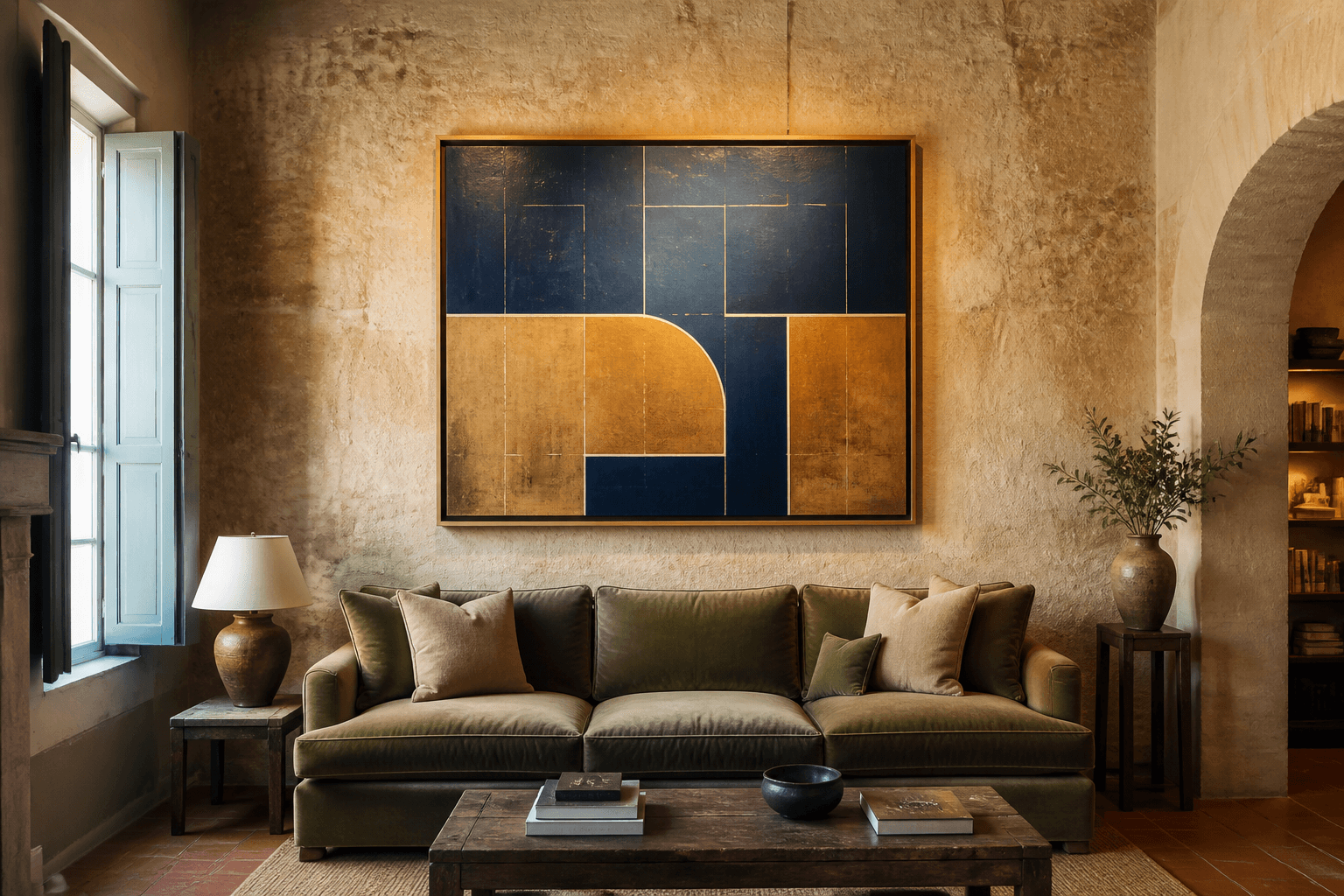
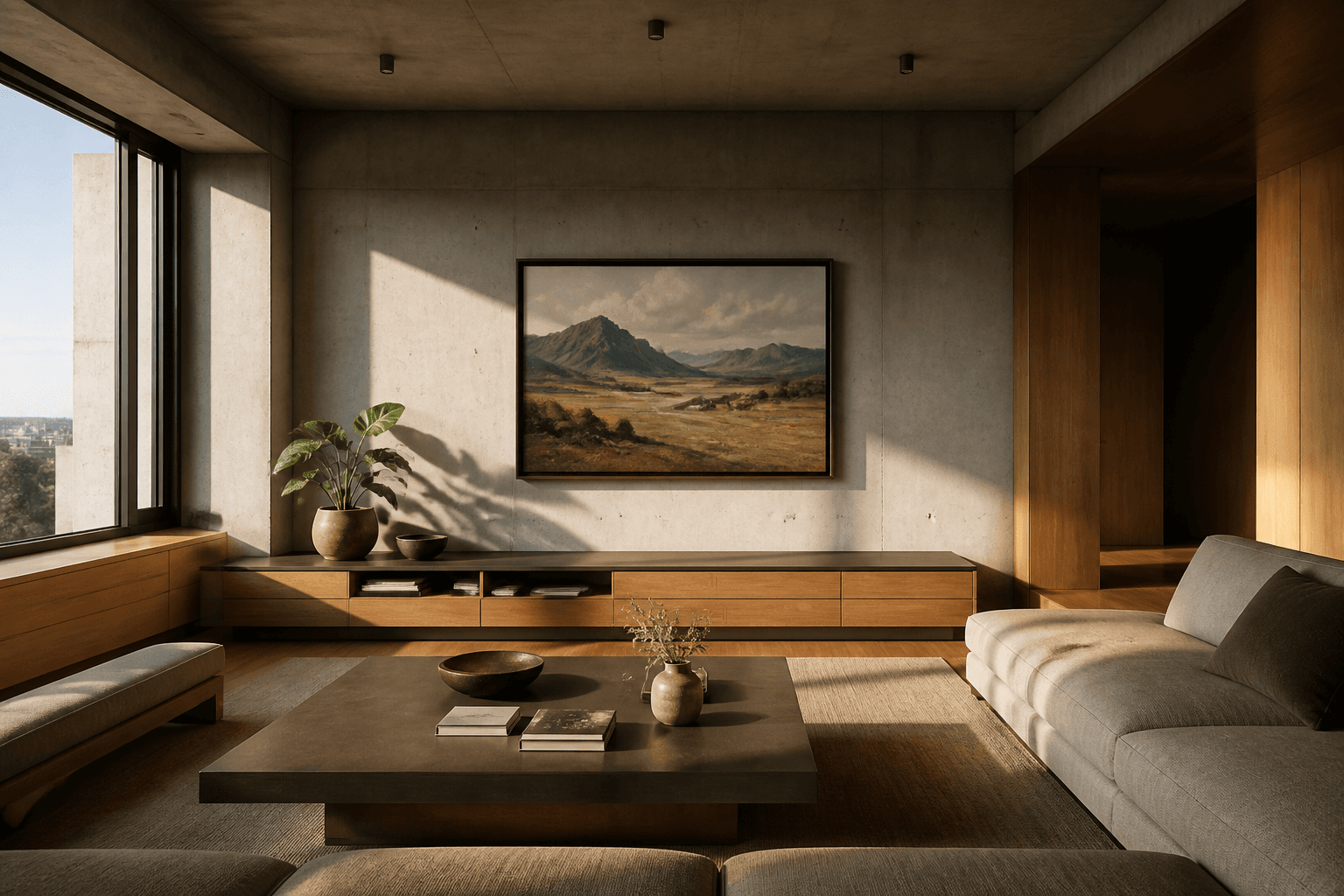
Original MOCKLIO screenshots (same upload path)
Below: photoreal room still and a cinematic-reel frame from MOCKLIO scenes we ship to artists. This is the output ArtPlacer's credit cap cannot match at weekly drop volume.
ArtPlacer is a comprehensive art marketing platform with 2,900+ room mockups, Virtual 3D Exhibitions, Personal Spaces for collector previews, CRM tools, a Presentations Suite, website widgets, and an Art Show Planner. It's genuinely powerful, and priced from $9/mo (artist Basic) to $169/mo (business Premium). It's primarily architected for galleries, art advisors, and full-time professional artists managing large inventories. Its core gap for indie artists selling online: video is credit-capped (1–2 generations per 30 days on artist plans), the workflow favors gallery operations over social-first weekly drops, and most independent artists will not use the CRM and exhibition stack. MOCKLIO is the ArtPlacer alternative built specifically for indie artists who need gallery-quality mockups, cinematic video reels for Instagram Reels and TikTok, and a clean publish-ready portfolio, all in one weekly workflow under an hour.
What is Artplacer and Why Are Artists Looking for Alternatives?
Artplacer (official website: artplacer.com) is an art presentation and marketing platform founded around the idea of letting buyers visualize artwork in their own spaces. Its core features, room mockup previews, virtual exhibitions, a CRM for gallery management, and a website widget, are genuinely useful if you manage an art gallery, represent multiple artists, or run a high-volume catalog operation.
The problem is that Artplacer was built for that professional gallery world. Most independent artists searching for an Artplacer alternative are running into three specific pain points:
- Pricing: Plans start at $9/month but quickly climb to $36–$144/month for anything beyond the basics. For a solo artist posting weekly, that ROI is hard to justify.
- Video is not cinematic catalogue volume: Credits are capped. Motion is typically a short zoom toward the canvas. Rooms and CRM stay strong; weekly exhibition reels do not.
- Gallery-first UX:The interface is built around large catalogs, client presentations, and physical show planning. If your workflow is "create one piece, drop it online this week," Artplacer feels over-engineered.
MOCKLIO was built specifically to fill those gaps: gallery-quality room mockups, cinematic video reels for social media, and a smart portfolio page, packaged in a weekly workflow designed for indie artists, not gallery managers.
I. The Honest Frame: What Kind of Artist Are You?
Before this comparison goes a single word further, let's establish something.
ArtPlacer is not a bad tool. It's a very good tool, for a specific kind of art professional. If you run a gallery, manage hundreds of artworks across multiple artists, need a CRM to track collector relationships, want to host 3D Virtual Exhibitions, and need website widgets that integrate with your existing e-commerce stack, ArtPlacer is legitimately impressive software. It deserves its audience.
But if you're an independent artist selling prints between $50 and $300 or originals between $300 and $5,000, running your sales through Instagram DMs, Etsy, or Shopify, you are not ArtPlacer's primary customer. You're the individual artist tier they offer at $9–$27/month. And the gap between what that tier costs you in time, learning curve, and mental overhead versus what it actually helps you do in a given week is where the problem lives.
The real question isn't "Which tool has more features?"
It's: "Which tool helps me ship a beautiful, professional weekly drop, and actually gets out of my way?"
That's a different question. And it has a different answer.
II. What ArtPlacer Actually Does Well
Let's give credit where it's substantial.
ArtPlacer's room mockup library is genuinely elite. Up to 2,800+ rooms on higher tiers, spanning residential spaces, modern galleries, museum settings, commercial environments, and seasonal layouts. The Smart Spaces feature lets you layer artwork behind objects in a room, so a painting can sit behind a sofa cushion or a lamp in the foreground, creating depth that makes the placement feel physically real rather than obviously composited. That's a meaningful technical differentiator.
The Personal Spaces feature is clever and useful for high-touch selling: you can upload a photo of a collector's actual home, accurately scale and hang your artwork on their wall using proper perspective, and share the preview directly with them. For artists selling originals to collectors who are uncertain about scale or fit, this tool alone can close sales that would otherwise require an in-person visit.
The Presentations Suite, available on Premium and Gallery plans, lets you build Portfolio Presentations, Viewing Rooms, Inventory Reports, and Artwork Labels that look polished enough to email directly to serious collectors or gallery curators. The Art Show Planner lets you digitally lay out a booth or gallery wall before a physical show, saving time and preventing expensive mistakes on hanging day.
The Discover profile gives your work a presence on ArtPlacer's own discovery platform, and the AR mobile app lets collectors point their phone at a wall and see your work in their actual space. These are genuinely impressive features for a certain use case.
There's nuance here:most independent artists selling primarily through Instagram and Etsy will use a fraction of this. The inventory cap on the Basic plan is 50 artworks. The Personal Spaces feature, the Virtual Exhibitions, the CRM, the Art Show Planner, these are gallery-tier features that individual artists will either not use at all or find locked behind higher pricing tiers. You're paying for infrastructure designed for a larger operation.
III. Where ArtPlacer Overshoots the Indie Artist
Here's what the feature list doesn't tell you.
Video is credit-capped, not cinematic by default. As of August 2026 ArtPlacer includes 1 video generation credit per 30 days on Basic and Standard, and 2 on Plus (official artist plans). That is not a weekly Reels engine. MOCKLIO Pro ships 2 cinematic 10-second room reels every month with camera movement, 16:9 and 9:16, from the same upload as your stills. Instagram and TikTok still amplify motion; one credit a month does not cover a Tuesday drop cadence.
This is still the biggest gap for indie volume: credit-capped generation versus cinematic room reels you can actually post every week.
Complexity as friction.ArtPlacer's feature breadth is a genuine strength for the gallery professional who uses it daily. For an indie artist trying to ship a weekly drop between a day job and studio time, it's overhead. Every feature you have to navigate past to get to the thing you actually need, a room mockup for Instagram, is a tax on your time and attention. The tool that's fastest to a finished, professional output is often the right tool, regardless of which one has more options.
The inventory cap problem.ArtPlacer's Basic artist plan caps you at 20 artworks in inventory. For a prolific artist or someone with a growing catalog, you'll hit that wall and face a plan upgrade before you've had time to evaluate whether the rest of the platform is working for you.
Pricing tiers designed for scale, not solo.The jump from Artist Basic ($9/mo, 20 artworks, 1,600+ rooms) to Artist Premium ($23/mo, 80 artworks, 2,800+ rooms, Virtual Exhibitions, Presentations) is substantial. And many of the features unlocked at Premium, Virtual Exhibitions, Portfolio Presentations, Art Show Planner, are gallery-native tools that solo artists selling via Instagram rarely need. You're paying for a platform that scales to gallery size while you're working at artist size.
The weekly drop isn't the product's native motion. ArtPlacer is built around inventory management, collector relationships, and professional presentations. These are slower-cadence workflows. The tool isn't architected around "I make a piece on Tuesday, I want it looking gallery-level and posted on Instagram by Thursday." MOCKLIO is.
No multi-angle mockups per room.ArtPlacer shows your artwork from a single perspective per room scene. There's no front view, left-angle, right-angle progression that gives you built-in content variety from one artwork. Three formats from one upload; ArtPlacer offers one.
You don't need a gallery operating system. You need a weekly selling system.
IV. ArtPlacer vs. MOCKLIO: Feature-by-Feature
| Feature | ArtPlacer | MOCKLIO |
|---|---|---|
| Platform | Web-based (all devices) | Web-based (all devices) |
| Room mockup library | 1,600–2,800+ rooms (tier-dependent) | Curated rooms, multi-angle per scene |
| Multi-angle views per room | ✗ Single angle | ✓ Front, left, right per scene |
| Cinematic video reels | ✗ None, on any tier | ✓ 10-sec HD, multiple camera movements |
| Video export for Reels/TikTok | ✗ | ✓ |
| Portfolio / Discover profile | ✓ ArtPlacer Discover (Advanced+ plans) | ✓ username.mockl.io with video integration |
| SEO from portfolio | ArtPlacer domain (large platform) | MOCKLIO domain authority |
| Personal Spaces (collector AR) | ✓ (Advanced+ plans) | ✗ |
| Virtual 3D Exhibitions | ✓ (Premium+ plans) | ✗ |
| CRM / Contact management | ✓ (Gallery plans) | ✗ |
| Website widget integration | ✓ (Gallery plans) | ✗ |
| Art Show Planner | ✓ (Gallery plans) | ✗ |
| Presentations Suite | ✓ (Premium+ plans) | ✗ |
| Art inventory management | ✓ 20–5,000 artworks (by tier) | Presentation-focused workflow |
| Weekly drop system | DIY | ✓ Built-in rhythm |
| Pricing | $9–$144/month | Free + Pro subscription |
| Free trial | 14 days | Unlimited single view image mockups |
| Target user | Galleries, professional artists, advisors | Indie artists selling online |
The table tells the story cleanly. ArtPlacer is a professional gallery operations platform with a strong mockup layer. MOCKLIO is a weekly selling system built around mockups, video, and portfolio, specifically for independent artists.
If you're also considering Smartist, see our Smartist vs MOCKLIO comparison. For Canvy users evaluating a switch, read our Canvy alternative guide.
They're not the same product category. They just overlap on room mockups.
V. The Weekly Drop System: Why Platform Complexity Kills Consistency
Here's the part nobody says out loud.
The tool you actually use consistently is worth more than the tool with the most features.
Every artist who has subscribed to a powerful platform and used it three times before letting the subscription quietly renew for six months knows exactly what this means. Complexity is the enemy of cadence. And cadence, a repeatable weekly rhythm, is the single biggest predictor of consistent online art sales.
The artists who build real revenue from Instagram and Etsy are not the ones with the most sophisticated inventory system. They're the ones who ship every week. New piece. Professional presentation. Multiple formats. Same loop, every Tuesday, every week, without reinventing the production from scratch.
Think about the quest loop: you finish a piece, you drop it with room mockups and a cinematic reel (two trust signals in two formats), it shows up in Reels where new audiences find it, they click your portfolio link, they buy. The loop resets. Next piece, next week.
ArtPlacer can handle the mockup frame of that loop. But it cannot handle the reel, the single highest-leverage format for organic reach in 2026. And its interface, built for gallery professionals navigating inventory, CRM, shows, and presentations, adds friction to a workflow that should be fast.
A tool built for galleries is not optimized for the artist who needs to be done by Thursday.
MOCKLIO's entire design is the opposite: minimum steps between "I have an artwork photo" and "I have a room mockup, a cinematic reel, and a published portfolio page." That's the weekly drop infrastructure. Not a feature list, a rhythm.
The simpler tool that you run every week beats the powerful tool that you use every other month.
VI. Two Real Artists, Two Different Needs
Example 1: Camille, watercolor artist selling prints on Etsy and Instagram
Camille signed up for ArtPlacer's Artist Advanced plan after seeing it recommended in an art marketing Facebook group. The feature list impressed her, Discover profile, room mockups, Personal Spaces. She used the room mockup tool consistently for about two months, producing clean static mockups for her Etsy listings.
Then life got busy. The Presentations Suite felt like extra homework. The Virtual Exhibitions were irrelevant, she wasn't running a gallery. The inventory cap on her plan started to feel tight as her catalog grew. And when Instagram's algorithm shifted hard toward Reels, she had nothing. ArtPlacer produced beautiful static images and nothing that moved.
She restructured her workflow: kept using ArtPlacer for the Personal Spaces feature when a collector wanted to see a commission in their home. Added MOCKLIO as her video and weekly drop system. The Reel content alone pushed her Instagram reach to audiences she'd never reached before, people who weren't already following her, finding her work through the algorithm rather than through hashtags.
She uses both now. But MOCKLIO became her weekly engine. ArtPlacer became a closing tool for high-value collector conversations.
Example 2: Dario, self-taught oil painter selling originals between $400 and $2,500 via Instagram DMs
Dario had a clear problem: he'd post a beautiful photo of a finished oil painting, get fifty likes, and maybe one DM. He couldn't figure out why pieces that took him thirty hours weren't converting into sales more consistently.
He tried ArtPlacer's free trial. The room mockups improved his static posts noticeably, his paintings in real-looking living rooms performed better than raw photos. But two things remained broken: he had no video presence at all, and when someone DM'd to ask about a piece, his response was still a chaotic mix of extra photos and prices typed out by hand.
He switched to MOCKLIO as his primary tool. His weekly drop now goes like this: finish the painting, generate two multi-angle room mockups (front and left-angle), create a 10-second cinematic reel with a slow push-in that makes the piece look large and considered, publish it all to his MOCKLIO portfolio page, send the portfolio link to anyone who asks. The reel drives reach. The portfolio handles every question a buyer might have before they commit.
His average time-to-sale went from four weeks to ten days. Not because he changed how he paints. Because he changed what buyers see before they decide.
VII. "But ArtPlacer Has So Much More…"
"ArtPlacer has 2,800 rooms. MOCKLIO's library is smaller."
More rooms is not a selling system. One cinematic 10-second reel of your artwork moving through a beautifully lit room will reach more new buyers in a single Reels post than fifty static alternatives ever will. Volume of mockup options doesn't compound. Video reach does.
"ArtPlacer has a Discover profile for collector exposure."
A valid feature, for artists with established galleries or larger collector bases. For indie artists building an Instagram audience and selling direct, a MOCKLIO portfolio page with your reels embedded and your username.mockl.io link as your bio link is the more immediate sales driver. Collector discovery platforms operate on a longer timescale than Instagram Reels.
"ArtPlacer has Personal Spaces, I can show my art in a collector's home."
Genuinely useful for high-touch sales of originals, especially commissions. If this feature is actively closing sales for you, keep ArtPlacer. These tools don't have to be mutually exclusive. Use ArtPlacer's Personal Spaces for collector conversations; use MOCKLIO for weekly drops and social reach.
"ArtPlacer's Basic plan is only $9/month, it's cheap."
The Basic plan caps you at 20 artworks, 1,600 rooms, and 20 design downloads per day. The features most artists actually want, 2,800+ rooms, Virtual Exhibitions, Presentations, Discover profile, start at the Advanced or Premium tier ($14–$23/month). And none of those tiers include video. You're not paying for a cheap tool. You're paying the entry price for a platform whose full value sits several tiers above you.
"I don't need video, my buyers find me through other channels."
You might be right. But if your existing channels aren't growing your audience beyond people who already know you, video is the missing lever. The Instagram algorithm in 2026 does not treat static posts and Reels as equivalent. If you're not publishing Reels, you're invisible to a significant portion of the buyers who would otherwise discover your work.
VIII. The Protocol: Art Photo to Weekly Drop in Under an Hour
- Take a clean photo of your artwork, phone camera, natural light, slightly overexposed rather than underexposed. Flat lay or straight-on against a neutral wall. This is your source file; make it count.
- Upload to MOCKLIO and generate 2–3 multi-angle room mockups , use front, left-angle, and right-angle views across different rooms. Gives you content variety for the whole week from a single artwork.
- Generate one cinematic video reel, match the camera movement to the work's mood. Slow, intimate push-in for detailed or emotional pieces; wider, steadier pan for large-format or landscape work.
- Publish your MOCKLIO portfolio page, add the piece with all mockups embedded and the reel front and center. This is your buyer destination. Update your link-in-bio to the page URL.
- Update your Etsy or Shopify listing, drop the best static mockup as the hero product image. Same traffic, higher conversion.
- Post the reel to Instagram Reels and/or TikTok, write a caption that establishes price, dimensions, and availability clearly. One CTA: "link in bio." Let the reel drive reach; let the portfolio close.
- Reply to every inquiry with your portfolio link, not a photo dump, not a rambling voice note, not a PDF. One clean link that pre-answers every question a buyer has before they decide.
Seven steps. Repeatable. Under an hour. That's what a weekly drop looks like when it has the right infrastructure under it.
IX. Key Takeaways
- ArtPlacer is a genuinely powerful platform, but it's primarily architected for galleries, art advisors, and professional artists managing large inventories, not indie artists with weekly drops and Instagram-native audiences.
- ArtPlacer caps video at 1–2 generation credits per 30 days on artist plans. MOCKLIO Pro includes 2 cinematic 10-second room reels per month. Reels and TikTok still reward motion you can ship weekly.
- ArtPlacer shows a single angle per room mockup; MOCKLIO provides front, left, and right angles per scene, generating more visual content variety from a single artwork upload.
- Complexity kills cadence. A simpler tool you actually run every week outperforms a feature-rich platform you navigate every other month.
- ArtPlacer's meaningful extras for indie artists (Personal Spaces, presentations, CRM) start at Standard and Plus ($16–$27/mo monthly), above Basic.
- Galleries should run both: ArtPlacer (or CMS) for CRM and rooms; MOCKLIO for cinematic hangs. Artlandish is the named presentation proof (Scott Linklater). Gallery is 50 videos/mo. Need more volume? Contact us at contact@mockl.io.
- A username.mockl.io portfolio page with embedded video reels is a more immediate sales driver for Instagram-native indie artists than a collector discovery profile on a gallery platform.
- The goal isn't the most features. It's the fastest path from finished artwork to a professional weekly drop, every Tuesday, every week, without burning your studio time on production.
Related Guides
X. FAQ
Is ArtPlacer free?
No. ArtPlacer is not a free mockup generator. Public pricing starts at $9/month for artist Basic ($8/mo billed yearly), with a time-boxed trial. Unlimited front-view stills with no card live on MOCKLIO Free. ArtPlacer's value is the gallery OS (rooms, CRM, exhibitions), not a $0 stills tier.
ArtPlacer vs MOCKLIO: which should I buy?
ArtPlacer vs MOCKLIO is a job split. Buy ArtPlacer if you need collector CRM, Personal Spaces, virtual exhibitions, and 2,900+ rooms for a roster. Buy MOCKLIO if you need unlimited stills, multi-angle exports, and cinematic room reels for Instagram/Etsy every week. Many galleries keep ArtPlacer for operations and add MOCKLIO for video. Indie artists posting weekly almost always get more conversion per dollar from MOCKLIO Pro at $19 than from ArtPlacer Basic plus a separate video tool.
Is MOCKLIO a good ArtPlacer alternative for indie artists?
Yes, particularly for independent artists selling primarily through Instagram, Etsy, or Shopify who need cinematic video reels, multi-angle mockups, and a portfolio page built around a weekly drop workflow. ArtPlacer is better suited to galleries and professional artists managing large inventories and collector relationships.
Can I use MOCKLIO and ArtPlacer together?
Yes. Galleries keep ArtPlacer (or another CMS) for CRM, rooms, Personal Spaces, and roster. MOCKLIO does cinematic 10s/12.5s hangs, batch catalogue video, and social/fair export. MOCKLIO does not replace a datafeed. Indie artists often keep Personal Spaces for commissions and use MOCKLIO as the weekly reel engine.
Does ArtPlacer make video mockups or cinematic reels for Instagram?
ArtPlacer includes 1–2 video generation credits per 30 days on artist plans (4–16 on business). That is not MOCKLIO-style cinematic 10-second room reels with camera movement and dual aspect export. If your channel is Instagram Reels, MOCKLIO is the video tool; ArtPlacer is the gallery OS.
How many room angles does ArtPlacer show per scene?
ArtPlacer shows a single angle per room scene. MOCKLIO provides front, left-angle, and right-angle views per room, giving you three times the content variety from a single artwork upload.
What is ArtPlacer's pricing for artists?
ArtPlacer artist plans (monthly): Basic $9 (50 artworks, 1 video credit, 30 downloads/day), Standard $16 (100 artworks, 1 credit, 10 Personal Spaces), Plus $27 (500 artworks, 2 credits, exhibitions). Yearly is $8 / $14 / $23 per month. Business: Professional $45, Growth $89, Premium $169 monthly ($40 / $77 / $144 yearly). Source: ArtPlacer help, 31 Aug 2026.
What makes MOCKLIO different from ArtPlacer for selling art online?
Three things ArtPlacer does not treat as the product: cinematic 10-second room reels as the default output, multi-angle views per scene, and a weekly drop path from upload to portfolio to posted reel in under an hour. ArtPlacer video is a credit add-on on a gallery OS.
How do I showcase my artwork online without expensive software or a studio?
Upload your artwork photo to MOCKLIO: generate curated room mockups, create a cinematic reel, and publish a portfolio page, all in one browser session with zero design skills required.
What is the weekly drop method for selling art and why does it work?
A weekly drop is a repeatable system: finish a piece, present it with mockups and video, publish it to your portfolio, post it across your channels, same loop, every week. Consistency builds audience trust and algorithmic momentum that compounds into predictable monthly revenue rather than unpredictable spikes.
Is ArtPlacer worth it for an independent artist in 2026?
ArtPlacer is worth it if you actively use its gallery-tier features: Personal Spaces for collector previews, Virtual Exhibitions, Presentations Suite, or the Art Show Planner. If you primarily need room mockups and social content for a weekly drop, the platform's complexity and video gap make it harder to justify over a more focused alternative.
What's the best art mockup tool for Instagram Reels and TikTok?
MOCKLIO is purpose-built for cinematic art reels, 10-second HD animations with professional camera movements that are optimized for short-form video platforms. ArtPlacer's 1–2 monthly generation credits will not cover a weekly Reels cadence.
Should a gallery drop ArtPlacer for MOCKLIO?
No if they rely on CRM, viewing rooms, or thousands of scenes. Add MOCKLIO for the presentation layer when they need 25–50 catalogue videos a month on 80cm+ work. Gallery plan is $299/mo for 50 videos. Run both rather than forcing one OS.
XI. Conclusion
ArtPlacer is an impressive platform. That's not the debate.
The debate is simpler: are you running a gallery, or are you an independent artist trying to sell your work online consistently every week?
If it's the former, if you're managing a large inventory, running 3D Virtual Exhibitions, building collector relationships through personalized Presentations, planning art fair booths, ArtPlacer is built for you and worth every dollar of the relevant tier.
If it's the latter, if you're an artist posting to Instagram three times a week hoping the right buyer finds you, selling direct via DMs and Etsy, trying to figure out why your work doesn't look as good online as it does in your studio, ArtPlacer has a room mockup library you'll use and a lot of infrastructure you won't. And video is a monthly credit, not a cinematic Reels engine. In 2026 that gap still decides who compounds.
That's the gap. Not a small one.
The compressed mental model: your artwork is the product, your mockups are the proof of scale, your cinematic reel is the reach engine, your portfolio page is the close. ArtPlacer handles one of those four things for indie artists at a price and complexity level that was built for a much larger operation. MOCKLIO handles all four in one workflow, every week, under an hour.
Feature count is a vanity metric. Consistency is the variable that compounds.
Build the right system for the business you actually have, not the one you might have someday. Galleries: keep the CRM, add cinematic hangs. Start a Gallery plan trial.
Make the art. Build the system. Let it sell.
– MOCKLIO Team