Portfolio Mistakes That Kill High-Ticket Sales (and Fixes) for Artists in 2026
Last updated: July 4, 2026
High-ticket art sales fail when your portfolio hides risk, scope, and next steps. Learn typical artist portfolio mistakes that kill luxury and commission sales, how to fix them, and how MOCKLIO smart portfolio pages combine video mockups, image mockups, and a deal-room for the full funnel.
Posted by
 Basti
BastiRelated reading
Gallery Content Pack: Reel, Stills, Carousel, Captions
Gallery content pack from one hang: 10s Reel, 12.5s cinematic cut, three stills, carousel, captions. Loop Hub and Share Pack for catalogue teams.
How Galleries Market New Arrivals Online in 2026
How art galleries market new arrivals online: inventory photos, MOCKLIO mockups and cinematic reels, collector email preview, Instagram schedule, and website sync.
Why Large Works Die as JPEGs (What 80cm+ Needs Online)
JPEGs flatten 80cm+ canvases on phones. Show scale with a photoreal room hang plus cinematic camera. Artlandish: buyers need a real home, not a stamp.
Short answer: High-ticket art and commission sales rarely die because your craft is weak. They die because your portfolio fails at trust, context, and a clear path to payment. The most expensive mistakes are invisible navigation, no proof of fit, missing pricing boundaries, weak motion presentation, and no dedicated sales conversation space. Fix those with structured storytelling, room and video mockups, explicit terms, and a deal-room so serious buyers never guess what happens next.
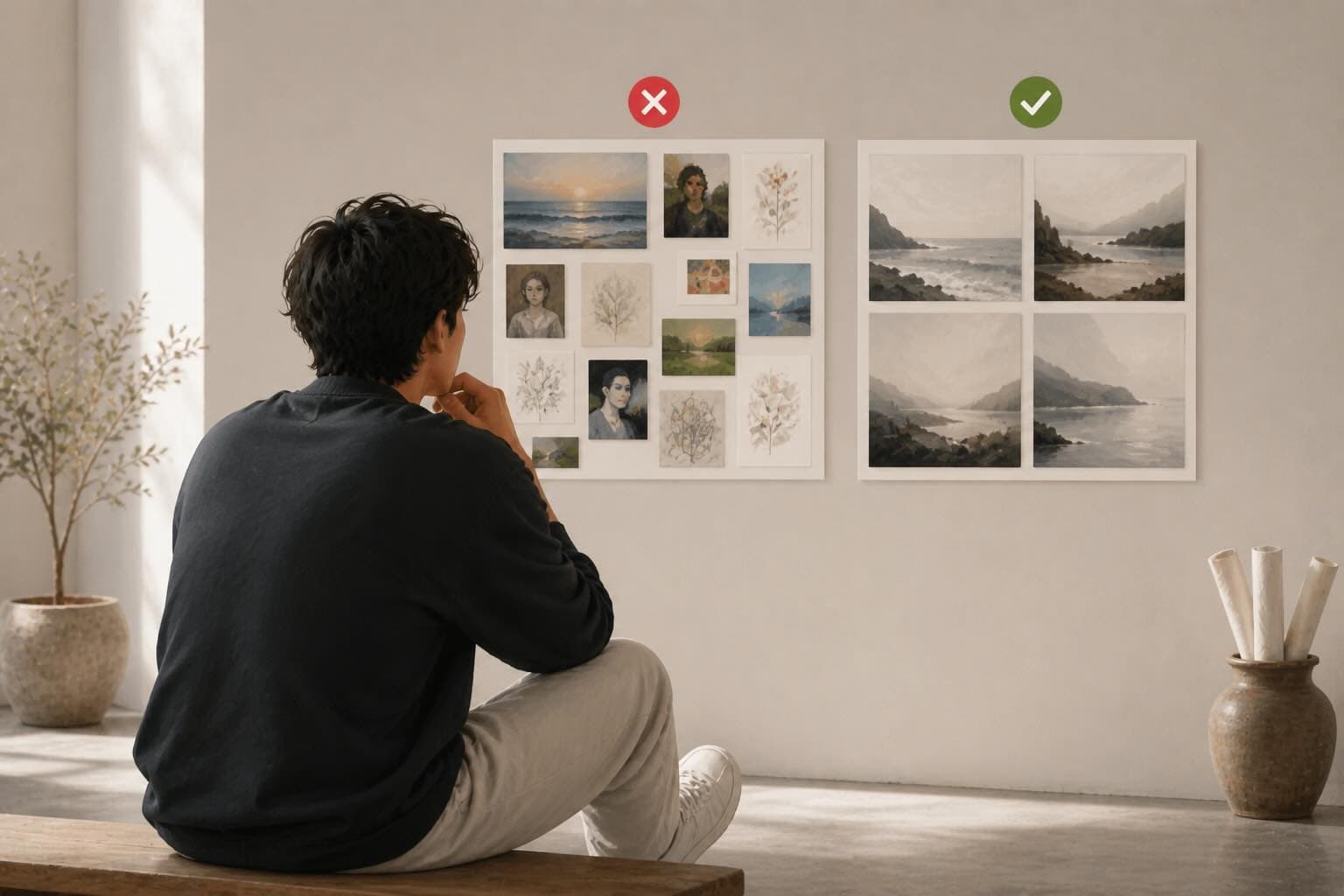
Table of Contents
- I. Why Portfolio Quality Decides High-Ticket Outcomes
- II. The 10 Portfolio Mistakes That Cost Artists Luxury Sales
- III. How to Fix Each Mistake (Practical Checklist)
- IV. MOCKLIO Smart Portfolio: Video Mockups, Image Mockups, and a Deal-Room for the Full Funnel
- Common Objections
- FAQ: Artist Portfolio and High-Ticket Sales
- Key Takeaways
- Conclusion
I. Why Portfolio Quality Decides High-Ticket Outcomes
A buyer considering a large original, a mural-scale commission, or a corporate placement is not looking for pretty thumbnails. They are buying certainty: fit, scale, credibility, timeline, and professional delivery. Your portfolio is the proof layer between interest and payment.
If that proof layer is messy, buyers do not always say no. They stall. They ask endless questions. They compare you to competitors who look more organized. In high-ticket selling, hesitation is the quiet failure mode.
Strong artist portfolios in 2026 treat each project like a case file: visual proof in context, motion where helpful, boundaries and process clarity, and a single controlled next step for qualified leads. That is the standard that wins premium inquiries.
The gap is rarely talent. It is operational proof. Collectors, interior designers, and corporate buyers compare you with artists who look equally strong on social. Your site answers the quiet questions: scale, framing, shipping and install risk, revisions, response time, and what happens if scope shifts mid-project. Portfolio conversion for high-ticket art is about compressing uncertainty, not adding decoration.
II. The 10 Portfolio Mistakes That Cost Artists Luxury Sales
These mistakes show up everywhere: personal sites, Behance templates, and social-only portfolios. You can fix them without a full rebrand.
1. Portfolio is only a gallery wall of JPEGs
Buyers cannot feel depth, texture, or installation scale from one flat crop. High-ticket purchases need spatial imagination. If every piece looks like a catalog square, you force the buyer to do mental gymnastics about size and materiality.
2. No context: no room, no lighting, no scale cue
Without context, the default mental model is "maybe it is small, maybe it is big". Ambiguity kills confidence. Add believable room context or at least a physical reference: a frame edge, a sofa line, a standard doorway, or a human silhouette when appropriate.
3. Missing motion for work that depends on surface and presence
Many premium pieces sell on presence. Static files undersell the experience. Glaze shifts, metallic peaks, impasto ridges, and layered pigment read differently when the eye can move across the surface.
4. No clear offer ladder
Visitors see art but do not know what is available: originals only, commission openings, prints, timelines, starting price bands, or minimum project size. If nothing is labeled, the safest response for a busy buyer is silence.
5. Buried contact path
Serious buyers will not hunt for an email address after scrolling through 40 images. Put the next step where decisions happen: above the fold on flagship pages and at the end of every major project story.
6. Weak trust signals for high-ticket risk
No process description, no delivery framing, no revision language, no installation notes. It reads like hobby presentation, not professional execution. High-ticket sales need risk reduction: what you ship, how you pack, what you insure, how you de-risk damage, and how you handle deadlines.
7. Inconsistent visual branding
If every project page looks like a different brand, buyers quietly question operational stability. Consistency does not mean identical posts; it means repeatable presentation quality and one coherent voice.
8. Too much story, not enough buying clarity
Story matters, but high-ticket buyers also need logistics, timelines, and decision steps. Inspiration without logistics reads like a diary, not a business.
9. No structured path after inquiry
The portfolio generates a lead, then the sales process happens in scattered DMs without a single professional workspace. That is where deals slow down: assets get lost, approvals drift, and nobody owns the next step.
10. Portfolio content that is not optimized for search or AI retrieval
Thin captions, missing headings, vague titles, and no FAQ-style answers reduce SEO and GEO visibility when buyers and assistants research options online. Answer real questions in plain language on the page, not only in captions on social.
These mistakes compound into admiration without action. Fix uncertainty first, then refine aesthetics.
III. How to Fix Each Mistake (Practical Checklist)
Monthly audit: fewer steps between "I get it" and "I can justify this". Upgrade your top revenue drivers first.
- Context wins: show each flagship piece with room mockups from multiple views so buyers feel scale and fit.
- Motion when it matters: add short cinematic clips for texture-heavy work and large formats.
- One offer per project page: label what is for sale, what is a sample, and what is commission-only.
- Visible CTA block: repeat inquiry, calendar, or application link at the top and bottom of key pages.
- Process in plain language: discovery, concept, milestones, revisions, delivery. Even five lines reduce anxiety.
- Trust stack: press, past clients, installation photos, certificates, or awards where real.
- SEO + GEO hygiene: descriptive page titles, structured headings, and FAQ-style answers for common buyer questions.
- Mobile check: most first looks are on a phone. Hero mockups must still read for scale. Tiny art in a cavernous room fails fast.
- Luxury editing: fewer projects with deeper stories beats a thumbnail dump. Curate like an exhibition.
Compare this checklist to our guide on commission mockups and client presentations. The overlap is trust through visualization, not image volume.
Document a repeatable commission workflow so the portfolio starts a path from first look to deposit and delivery, not a dead end.
IV. MOCKLIO Smart Portfolio: Video Mockups, Image Mockups, and a Deal-Room for the Full Funnel
MOCKLIO smart portfolio pages support the full buyer journey: create premium media, present it professionally, then move qualified buyers into a structured deal flow. Upgrade the pages that earn high-ticket attention, not your entire site at once.
Image mockups that answer "will it fit?"
Room image mockups attack spatial uncertainty, the core high-ticket objection. See art mockups in MOCKLIO for believable interior placement, then sequence your flagship works with cropping that reinforces scale.
Video mockups that communicate presence
Short cinematic presentation adds depth cues stills miss. Pair selective gallery reels with your best pieces, not every file.
A deal-room for the sales funnel
When email, DMs, and stray links split the thread, deals stall. A deal-room keeps questions, assets, and approvals in one workspace so the narrative does not dissolve. Portfolio pulls interest; deal hygiene closes it.
Why this matters for revenue
The portfolio gets the meeting. The funnel gets the signature. If you only fix the gallery wall but ignore the handoff, you still lose high-ticket deals at the finish line.
Explore MOCKLIO pricing and map one flagship project end to end: mockups, reel, portfolio page, and deal-room flow.
Common Objections
"Luxury buyers want minimal sites. Is this too much?"
Minimal can still be complete. The goal is clarity, not clutter. One hero project with strong context often outsells twenty chaotic pages.
"I do not want to look salesy."
Professional structure is not salesy. Confusion is what feels unprofessional. Clear process and next steps reduce pressure because buyers know how you work.
"Do I need video for every piece?"
No. Use motion for flagship works and anything where materiality drives value perception.
FAQ: Artist Portfolio and High-Ticket Sales
What is the biggest portfolio mistake for high-ticket sales?
The biggest mistake is showing art without reducing buyer uncertainty about scale, context, process, and next steps.
How do room mockups help sell expensive art?
They help buyers visualize installation outcomes and reduce fear of mismatch, which is a major brake on large purchases.
Should I list prices on my portfolio?
You can use ranges, starting points, or application-only pricing. The mistake is providing no economic signal at all, which filters out serious buyers and attracts the wrong inquiries.
Which keywords help SEO and GEO for portfolio pages?
Target clusters like artist portfolio, online art portfolio, high-ticket art sales, art commission workflow, room mockups for artists, sell original art online, and art sales funnel.
How does MOCKLIO fit a complete sales funnel?
MOCKLIO supports media creation and presentation through image and video mockups, plus portfolio-style presentation and a deal-room layer for moving qualified leads toward close.
Key Takeaways
- High-ticket sales depend on certainty more than taste alone.
- Flat galleries, missing context, and unclear offers quietly kill premium conversions.
- Room mockups and selective motion increase perceived fit and value.
- Professional process language reduces risk and speeds decisions.
- A deal-room-style flow prevents leads from dissolving in scattered messages.
- SEO and GEO-friendly structure makes your portfolio more discoverable and citable.
Related Guides
Conclusion
Your portfolio is not just a showroom. It is the first half of a high-ticket sales system. If it only impresses but does not clarify fit, scope, and next steps, you will keep losing luxury deals at the silent hesitation stage.
Fix the mistakes with context-rich presentation, motion where it matters, and a structured buyer path. Then support the full funnel with MOCKLIO smart portfolio capabilities: image mockups, video mockups, and a deal-room that keeps serious buyers moving from interest to agreement.
- MOCKLIO Team