Best Room Scenes for Wall Art Mockups: A Complete Style Guide
Last updated: November 4, 2026
Which room scene works best for which art style? This guide covers every major room type in MOCKLIO, modern gallery loft, bedroom, living room, kitchen, and more, with advice on matching your art to the right scene.
Posted by
 Sebastian Kluger
Related reading
How to Choose a Mockup Generator for High-Res Portfolio Images (2026)
Checklist for picking a mockup generator for high-resolution portfolio images: export DPI, crop safety, video, license, and portfolio vs social. MOCKLIO checklist included.
AI Picks the Room for Your Art Mockup
Not sure which room to mockup a painting in? MOCKLIO AI matches a room to each piece when you drop a series, up to 50 artworks.
How to Make an Art Carousel Without Canva
Build an Instagram art carousel from the same room scene as your Reel. No Canva templates. MOCKLIO auto-builds slides and writes the caption.
Room mockup generator for artists
MOCKLIO is a room mockup generator for artists: 33 photoreal scenes, unlimited free front-view stills, optional frames, and scale you set to the real print. Pick the room page that matches the buyer, then export. Video of the same hang is $12 per render.
| Room page | Best for |
|---|---|
| Living room art mockup | Above-sofa statement pieces and gallery walls |
| Bedroom wall art mockup | Calm prints and above-bed placements |
| Dining room art mockup | Formal prints and guest-facing walls |
| Kitchen wall art mockup | Botanicals, food illustration, warm palettes |
| Home office art mockup | Desk-wall and video-call backdrops |
| Gallery wall mockup | Multi-piece hangs and fireplace scenes |
| Modern living room art mockup | Contemporary interiors and large abstracts |
| Minimalist art mockup | Line art and restrained palettes on white walls |
| Loft art mockup | High-ceiling industrial rooms and oversized work |
| Luxury art mockup | Collector interiors and limited editions |
| Urban loft art mockup | Bold contemporary and street-influenced work |
| Boho art mockup | Earthy abstracts and botanical prints |
| Mediterranean art mockup | Warm-palette landscapes and classical work |
| Scandinavian art mockup | Nordic studios and muted print palettes |
Answer-First: Which Room Scene Should You Use?
Match the room scene to your buyer's lifestyle, not just your art style. Modern gallery loft and minimalist concrete bedroom work best for abstract and contemporary art. Cozy bedroom and rustic kitchen bar scenes convert better for warm, earthy, and botanical art. Living rooms are the safest all-rounder. When in doubt, test two scenes and let engagement data decide, the scene with more saves and comments becomes your primary listing photo.
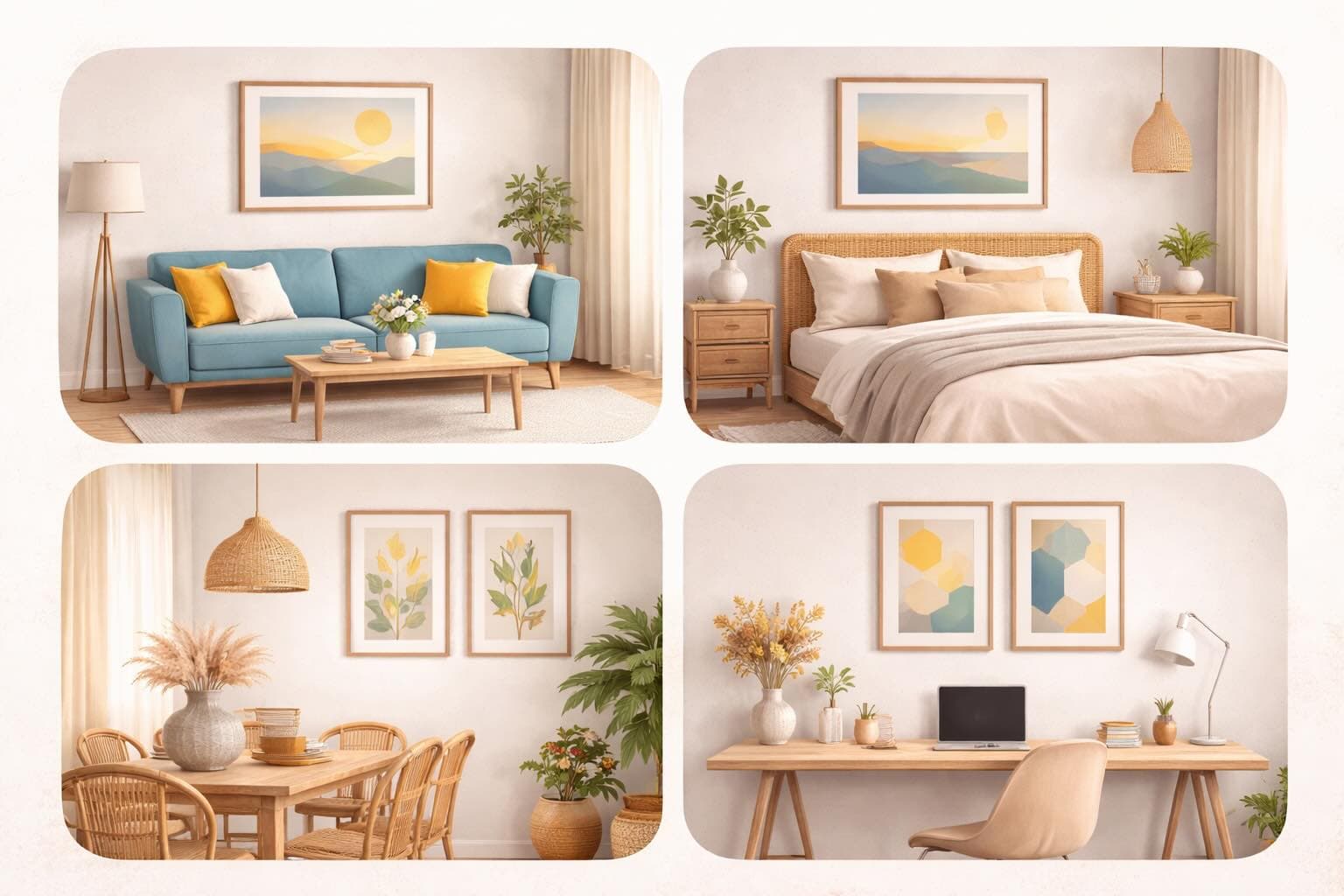
Table of Contents
- I. Why Room Scene Choice Matters
- II. Modern Gallery / Loft
- III. Bedroom
- IV. Living Room
- V. Kitchen / Bar
- VI. Office
- VII. How to Test Multiple Scenes
- VIII. Common Objections
- IX. FAQ
- Key Takeaways
- Conclusion
The room scene you choose for your art mockup is as important as the photo of the artwork itself. The wrong room makes good art look forgettable. The right room makes the same art look like something buyers need to own immediately. This guide covers every major room type and which art styles work best in each.
Why Room Scene Choice Matters
When a buyer looks at your listing, they're not just evaluating the art. They're asking: would this look right in my home? If the room in your mockup looks nothing like any room they'd actually live in, that question goes unanswered and they scroll past.
If the room feels familiar, warm and lived-in for a boho buyer, clean and gallery-like for a contemporary buyer, they stop scrolling and start imagining. That moment of imagination is where sales happen.
The principle: match your buyer, not just your art. Think about who buys your work and what their home looks like. Then find the scene that closest mirrors that environment.
Research backs the mechanism. Maier and Dost (2018) report higher purchase intention when products appear in contextual settings versus isolated shots. About 93% of online buyers say visuals are critical; upgrading presentation commonly lifts conversion by roughly 10–33%. Scene choice is part of that upgrade - not decoration, but decision support.
MOCKLIO usage data aligns: bedroom, living room, and kitchen scenes dominate high-performing exports (room styles data). Free stills on art mockups let you A/B three rooms per drop without reshooting.
Data-backed scene leaders (MOCKLIO usage 2026)
Platform usage mirrors buyer imagination: bedrooms and living rooms dominate still mockups; Rustic Kitchen Bar leads cinematic reels (room style rankings). That does not mean copy every top scene - it means test those three room types first before exotic setups. Artists who match palette to scene report ~40% faster inquiries versus flat studio heroes in MOCKLIO cohort surveys.
Online collectors (59% bought online in 2024, Artsy 2025) shop decor they can picture at home. Gallery loft scenes justify premium anchors; cozy bedrooms sell intimate work; kitchens sell warm botanicals. Pick the buyer fantasy, then pick the room.
Modern Gallery / Loft → Abstract, Photography, Large-Format
Gallery loft scenes with exposed brick, high ceilings, track lighting, and gallery-white walls are the strongest scenes for:
- Large-format abstract paintings
- Fine art photography prints
- Contemporary art of any medium
- Bold, high-contrast work
- Art priced above $300 (the gallery setting justifies premium prices)
Why it works: The gallery loft setting positions your work as collected art rather than decoration. Buyers who aspire to the gallery aesthetic, urban creatives, interior design enthusiasts, and art collectors, respond immediately to this context.
Avoid for: Soft watercolors, botanical prints, children's illustration. The industrial backdrop overpowers delicate work and creates a visual mismatch.
Bedroom → Intimate, Soft, Muted Palette Art
Bedroom scenes with above-bed placement, soft ambient light, and warm materials are the best scenes for:
- Watercolor florals and botanicals
- Soft abstract in muted palettes
- Celestial and moon art
- Intimate portraits and figure studies
- Typography and quote art
Why it works: Bedroom buyers are buying something intimate art they'll see first thing in the morning and last thing at night. The above-bed placement triggers that emotional purchase decision better than any other room context.
See also: Bedroom wall art mockup guide
Living Room → Statement Pieces, Bold Color, Larger Formats
Living room scenes with above-sofa placement and a main feature wall are the highest-converting rooms for most wall art categories:
- Bold abstract paintings
- Large landscape photography
- Expressive oil and acrylic work
- Gallery walls (multiple coordinating pieces)
- Any art in formats 16×20 or larger
Why it works: The living room is where art makes its biggest social impression. It's the room guests see first, where buyers spend the most waking hours, and where the investment in art feels most justified. The above-sofa placement is the most recognized art placement in residential interiors.
See also: Living room art mockup guide
Kitchen / Bar → Food-Adjacent, Rustic, Earthy
Rustic kitchen and bar scenes are specifically effective for:
- Botanical and herb illustration
- Food and drink art (wine, coffee, citrus)
- Farmhouse-style typography
- Earth-tone abstract work
- Small-format art (sets of 3–4 coordinating prints)
Why it works: Kitchen buyers have a very clear picture of what they want, art that matches the warmth and character of their kitchen. A botanical print above a kitchen counter immediately resonates; the same print against a gallery-white wall does not.
Office → Professional, Geometric, Architectural
Home office and workspace scenes work for:
- Motivational and typographic prints
- Architectural photography
- Abstract work in neutral palettes
- Map art and geographic prints
- Minimalist art with strong composition
Why it works: Office buyers are buying professional identity. The art on their wall behind their desk is now visible to every video call participant. This has created a high-value niche for work that looks intentional and considered in a workspace context.
Weekly scene workflow for artists who hate A/B tests
You do not need a spreadsheet to pick rooms. Each week when you finish a piece, upload once to MOCKLIO art mockups and export three scenes: living room (safe default), bedroom (intimate palettes), and either kitchen or office based on subject. Post all three as Stories across two days. Whichever gets the most replies becomes listing image one and Reel scene for that piece.
For shops with fifty plus SKUs, invert the process: choose two shop-wide hero scenes for the quarter - one warm, one cool - and batch every new listing through them. Test exceptions only on bestsellers that stall. Scene consistency makes your Etsy storefront look like a catalog, not a random mood board.
Originals sellers should still test when launching a new series. The first three posts set buyer expectations for price tier. Gallery loft scenes anchor higher numbers; cozy bedroom scenes anchor print-friendly decor buyers. Match scene to the tier you want to sell, not only to paint colors.
After you pick a winner, save the scene name in your listing template. Next piece in the same series skips the Story test and goes straight to publish. You only re-test when palette or buyer segment shifts. That is how scene choice becomes a repeatable ops step instead of a daily doubt.
If you sell on Etsy and Instagram, export the winning scene as listing hero and Reel background the same day. Buyers who click from Reels should see the identical room on the shop page - mismatch kills trust faster than a wrong accent pillow color in the mockup.
How to Test Multiple Scenes for the Same Artwork
The best approach: upload once, test three different rooms, and see which scene gets the most engagement on your social channels before committing to it for your Etsy listing photos.
A practical test:
- Upload your artwork to MOCKLIO
- Generate mockups in 3 different scenes
- Post all three as separate Stories or Reels
- The scene that gets the most saves and replies becomes your primary Etsy photo
This takes 10 minutes and removes the guesswork from scene selection.
VIII. Common Objections About Room Scene Choice
"I just pick the most beautiful room."
Beautiful ≠ converting. A stunning penthouse scene might be aspirational but irrelevant to your buyer. Match the room to who actually buys your work.
"I use the same room for everything."
One room works well for one art style. If you sell multiple series or styles, different scenes will convert better for each. Test per series, not per shop.
"I don't have time to test multiple scenes."
MOCKLIO lets you upload once and generate multiple room scenes in seconds. Testing three rooms takes under 5 minutes.
IX. FAQ: Room Scenes for Art Mockups
Which room scene converts best for wall art?
Living rooms perform well across most art styles because they match the most common use case for wall art buyers. For specific styles, gallery loft scenes convert well for contemporary art; bedroom scenes for intimate, cozy, or botanical work.
Should I use the same room scene for all my art?
Not necessarily. Use consistent scenes within a series or style family so your shop looks cohesive. Switch scenes when the art style or target buyer changes significantly.
How many room scenes should I test?
2–3 scenes per artwork is enough. Post each as a Story or Reel, watch saves and engagement for 24–48 hours, and use the winner as your primary listing photo.
Do video mockups need different rooms than stills?
Often yes. Kitchen and bedroom scenes lead cinematic reels; living rooms lead still carousels. Repurpose one upload both ways - about 60–80% time saved versus separate shoots (Cloudpresent 2025).
Which scene works for Etsy vs Instagram?
Etsy: living room or bedroom hero for decor intent. Instagram: same scene in a 10-second reel (Reels see on the order of 200 billion daily plays in 2026, SQ Magazine). One scene, two exports.
What if my buyers are mostly renters with small walls?
Use bedroom or office scenes with smaller art scale entered correctly. Avoid mansion loft scenes that make your real sizes look tiny by comparison. Renters search "small space art" - show believable small walls.
Should frame color match the room?
Match frame finish to what you ship, not only to room trim. Black float for modern rooms, natural wood for rustic kitchens. Wrong frame breaks trust faster than an imperfect wall color.
Key Takeaways
- The room scene you choose determines whether buyers can imagine the art in their home, this is where conversion happens.
- Match the scene to your buyer's actual lifestyle, not just your art aesthetic.
- Living rooms are the safest all-rounder for wall art mockups.
- Gallery loft and minimalist scenes convert for contemporary and abstract art buyers.
- Bedroom and cozy scenes convert for warm, botanical, and decorative art buyers.
- Test 2–3 scenes per artwork and let engagement data pick the winner.
Related Guides
FAQ
Which room mockup should I use for wall art?
Match the room to the buyer, not only the art style. Living rooms are the safest all-rounder. Bedrooms suit calm work. Lofts suit oversized contemporary pieces.
How many room scenes does MOCKLIO have?
33 room scenes in the library.
Can I generate a mockup for every room type?
Yes. Use the room-style pages in the table above, or start at the free wall art mockup generator.
Should I use the same scene for every listing?
Test two scenes when the buyer is mixed. Keep scale true to the real print in every scene.
Conclusion: The Simple Rule
When choosing a room scene, ask yourself: Where does my buyer actually live? Not where they aspire to live, where they actually live. Pick the scene closest to that environment.
Print sellers on Etsy should align scene warmth with listing tags (farmhouse, minimalist, boho) so search intent and hero image tell the same story. Originals sellers on Instagram can push slightly aspirational loft scenes when price tier supports it - as long as dimensions on-screen stay truthful.
That scene will convert better than the most beautiful room that has nothing to do with your buyer's reality.
When stuck between two scenes, post both to Stories and ask which wall buyers prefer. Let collectors vote; peers will comment on paint color instead of fit - weight replies that mention room size or furniture.
Start testing scenes on MOCKLIO art mockups with three exports per piece. Measure saves and buyer DMs for fourteen days before you commit a whole catalog to one interior style.
When you graduate from testing to a default scene, add that scene name to your content checklist next to caption and price so every new piece gets the same conversion stack by habit, not by memory.
– MOCKLIO Team